

AI Agents vs Chatbots vs Virtual Assistants: A Complete Guide to Modern AI Technologies
Estimated reading time: 6 minutes
Key Takeaways
- AI Agents, chatbots, and virtual assistants are distinct AI technologies, each with unique capabilities.
- Artificial Intelligence (AI) is the broader concept, while Machine Learning (ML) is a subset focused on learning from data.
- AI Agents are autonomous, making complex decisions and adapting from experience across multiple systems.
- Chatbots primarily handle simple, rule-based conversations for basic customer service tasks.
- Virtual Assistants excel at specific personal tasks like scheduling and reminders, responding to voice or text commands.
- Choosing the right AI solution requires careful consideration of task complexity, required autonomy, and integration needs.
Table of Contents
- 1. Introduction
- 2. Differences Between AI and Machine Learning
- 3. Understanding AI Agents, Chatbots, and Virtual Assistants
- 4. NLP vs AI Agent
- 5. AI Avatar vs AI Agent
- 6. RPA vs AI Automation
- 7. Digital Humans vs AI Agent
- 8. Chatbot vs Conversational AI vs Agent
- 9. Workflow Bot vs Chatbot
- 10. Choosing the Right AI for Business Tasks
- 11. Terminology in AI Automation
- 12. Conclusion
- Frequently Asked Questions
In today's digital world, AI agents, chatbots, and virtual assistants are everywhere. But what makes each one unique? This guide will help you understand the key differences between these AI technologies and choose the right one for your needs.
1. Introduction
Artificial Intelligence (AI) has transformed how we interact with technology. From simple chatbots answering basic questions to sophisticated AI agents making complex decisions, these tools are changing how businesses operate and how we handle daily tasks.
Dive deeper into how intelligent automation is revolutionizing various sectors.
At the center of this transformation are three key technologies: AI agents, chatbots, and virtual assistants. Each serves different purposes and offers unique capabilities to help businesses and individuals work smarter, not harder.
2. Differences Between AI and Machine Learning
Understanding AI Technologies
- AI (Artificial Intelligence) is the broader concept of machines being able to perform tasks intelligently.
- Machine Learning (ML) is a subset of AI that focuses on systems learning from data.
Key Differences:
- AI aims to create smart systems that mimic human intelligence.
- ML specifically deals with training systems using data.
- AI can make decisions, while ML identifies patterns.
[Source: The Pedowitz Group]
3. Understanding AI Agents, Chatbots, and Virtual Assistants
AI Agents
- Autonomous systems that can plan and act independently.
- Make complex decisions without human intervention.
- Learn and adapt from experiences.
- Handle sophisticated tasks across multiple systems. Read more on how AI agents transform work.
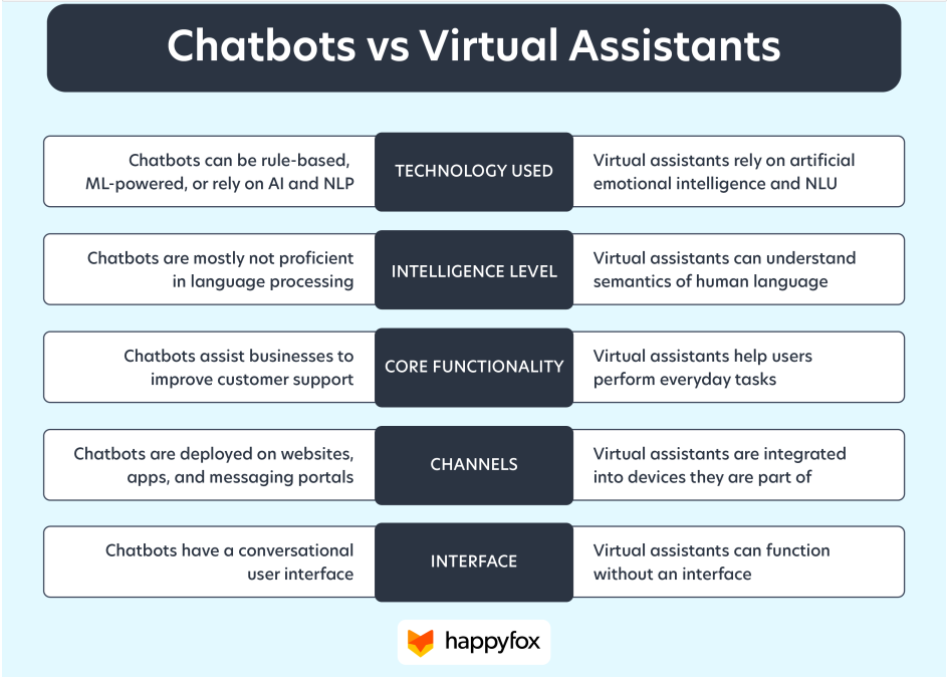
Chatbots
- Focus on simple conversations.
- Follow pre-set rules and scripts.
- Handle basic customer service tasks.
- Work best with straightforward questions. Explore best AI chatbot solutions for small businesses.
Virtual Assistants
- Help with specific tasks like scheduling.
- Understand voice or text commands.
- Manage calendar and reminders.
- Automate simple workflows.
[Source: Aisera Blog]
4. NLP vs AI Agent
Natural Language Processing (NLP)
- Technology that helps computers understand human language.
- Forms the foundation for modern AI communication.
- Enables understanding of context and meaning.
How AI Agents Use NLP
- Process complex conversations.
- Understand user intent.
- Extract important information.
- Handle multiple languages.
[Source: Aisera Blog]
5. AI Avatar vs AI Agent
AI Avatars
- Visual representations of AI systems.
- Focus on creating human-like appearances.
- Often used in customer-facing roles.
Comparing with AI Agents
- AI Agents focus on functionality over appearance.
- Agents work behind the scenes.
- Avatars prioritize visual interaction.
- Agents prioritize task completion.
[Source: Crescendo.ai Blog]
6. RPA vs AI Automation
Robotic Process Automation (RPA)
- Follows fixed rules and procedures.
- Automates repetitive tasks.
- Cannot adapt to changes.
- Works with structured data.
AI Automation
- Learns and improves over time.
- Handles complex, changing situations.
- Makes intelligent decisions.
- Works with both structured and unstructured data.
[Source: The Pedowitz Group]
7. Digital Humans vs AI Agent
Digital Humans
- Create lifelike interactions.
- Focus on emotional connection.
- Use visual and verbal communication.
- Enhance brand experience.
AI Agent Comparison
- Emphasize practical task completion.
- Focus on efficiency and results.
- Work without visual representation.
- Prioritize business outcomes.
[Source: Crescendo.ai Blog]
8. Chatbot vs Conversational AI vs Agent
Chatbots
- Handle basic conversations.
- Use simple decision trees.
- Provide quick, scripted responses.
- Limited learning ability.
Conversational AI
- Natural, flowing conversations.
- Learns from interactions.
- Understands context better.
- Improves over time.
AI Agents
- Complete complex tasks.
- Make autonomous decisions.
- Handle multiple systems.
- Continuously adapt and learn.
[Source: Salesforce]
9. Workflow Bot vs Chatbot
Workflow Bots
- Automate business processes.
- Follow specific procedures.
- Handle structured tasks.
- Work with multiple systems.
Chatbot Comparison
- Focus on conversation.
- Handle user inquiries.
- Follow simple scripts.
- Work within single channels.
[Source: Aisera Blog]
10. Choosing the Right AI for Business Tasks
Consider These Factors:
- Task complexity
- Required autonomy
- Integration needs
- Budget constraints. See our AI agent pricing guide.
- User experience goals
Best Uses for Each Technology:
- Chatbots: Customer service, FAQs
- Virtual Assistants: Personal tasks, scheduling
- AI Agents: Complex processes, business operations. Learn more with our ultimate guide to AI agents for small business.
- RPA: Repetitive tasks, data entry
- Digital Humans: Brand engagement, customer experience
[Source: IBM Think]
11. Terminology in AI Automation
Essential Terms:
- Machine Learning: Systems learning from data
- Natural Language Processing: Understanding human language
- Neural Networks: Advanced AI learning systems
- Deep Learning: Complex pattern recognition
- Automation: Task execution without human intervention. Discover how to implement an AI agent effectively.
Key Concepts:
- Artificial Intelligence: Broad term for smart systems
- Autonomous Systems: Self-operating technology
- Intent Recognition: Understanding user goals
- Entity Extraction: Identifying important information
- Machine Vision: AI understanding visual input
[Source: Crescendo.ai Blog]
12. Conclusion
Understanding the differences between AI agents, chatbots, and virtual assistants is crucial for making informed technology choices. Each tool serves specific purposes:
- AI agents excel at complex, autonomous tasks. Understand the limitations of AI agents.
- Chatbots handle simple conversations efficiently.
- Virtual assistants manage personal productivity tasks.
Choose the right tool based on your specific needs, considering factors like task complexity, required autonomy, and desired outcomes. As these technologies continue to evolve, staying informed about their capabilities and limitations will help you make better decisions for your business or personal use.
Remember: There's no one-size-fits-all solution. The key is matching the right technology to your specific requirements and goals.
[Source: The Pedowitz Group]
Frequently Asked Questions
- Q: What is the primary difference between an AI agent and a chatbot?A: AI agents are autonomous systems capable of planning, acting independently, and making complex decisions across multiple systems. Chatbots, on the other hand, are designed for simple conversations, following pre-set rules and scripts to handle basic inquiries.
- Q: How does Machine Learning relate to Artificial Intelligence?A: Artificial Intelligence (AI) is the broad concept of machines performing tasks intelligently. Machine Learning (ML) is a specific subset of AI that enables systems to learn from data, identify patterns, and improve their performance over time without explicit programming.
- Q: When should a business choose an AI agent over a virtual assistant?A: Businesses should opt for an AI agent for highly complex processes and critical business operations that require autonomous decision-making, adaptation, and interaction with multiple systems. Virtual assistants are better suited for specific, personal productivity tasks like managing calendars, setting reminders, or automating simple workflows.
- Q: What role does NLP play in AI agents?A: Natural Language Processing (NLP) is fundamental for AI agents, allowing them to understand, interpret, and generate human language. This capability enables agents to process complex conversations, comprehend user intent, extract important information, and communicate effectively across various languages.
12 thoughts on “AI Agents vs Chatbots vs Virtual Assistants: A Complete Guide to Modern AI Technologies”
Comments are closed.