

Chatbot Backend Architecture: A Complete Guide to Building Scalable AI Chatbots
Estimated reading time: 6 minutes
Key Takeaways
-
- Chatbot backend architecture is the *brain and nervous system* behind effective digital assistants.
-
- Key components include the message handler, brain center, memory bank, and connection hub.
-
- Modern chatbots leverage powerful AI frameworks like TensorFlow, PyTorch, Dialogflow, and Rasa for natural language understanding.
-
- *Intent recognition* is crucial, enabling chatbots to understand user needs through rule-based, machine learning, or deep learning approaches.
-
- RAG (Retrieval-Augmented Generation) systems enhance accuracy by combining stored knowledge with AI-generated responses.
-
- *Hybrid and microservices architectures* provide flexibility, scalability, and improved maintenance for complex chatbots.
-
- Cloud-based solutions offer significant advantages in terms of scaling, resources, and updates.
-
- APIs are vital for connecting chatbots to external services like payment systems, CRMs, and customer databases.
- Building a *scalable chatbot infrastructure* requires planning for growth with load balancers, auto-scaling, and robust monitoring.
Table of contents
Introduction
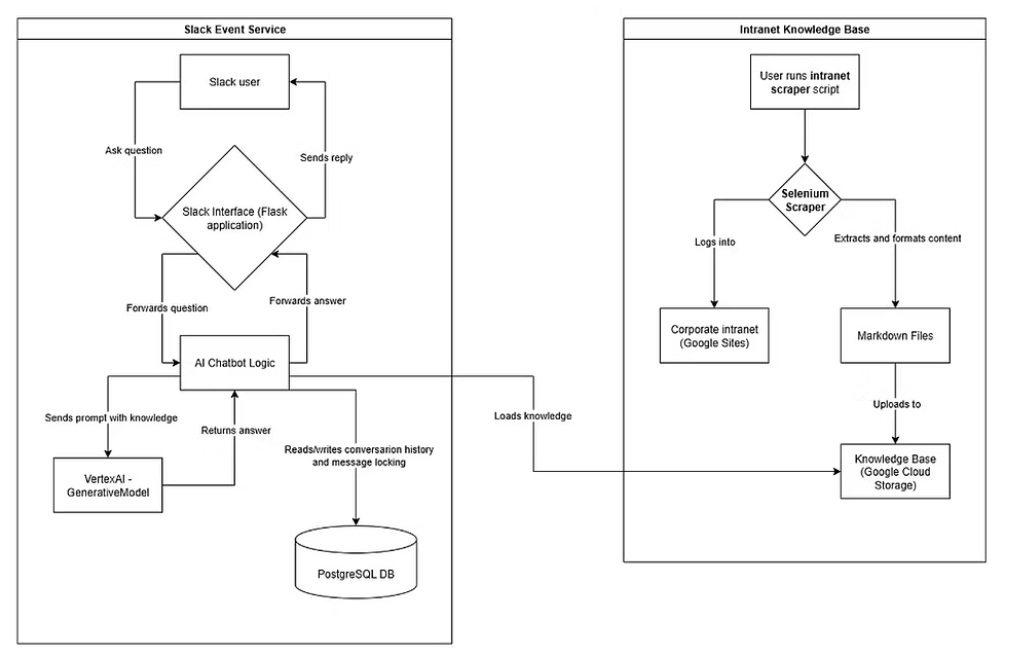
In today’s digital world, chatbots have become our everyday helpers – answering questions on websites, helping us shop online, and even providing customer support. Behind every smooth-running chatbot is something special called chatbot backend architecture. Think of it as the *brain and nervous system* that makes these digital helpers work so well.
For small businesses looking to leverage this technology, exploring Best AI Chatbot Solutions for Small Businesses can provide a competitive edge. It’s also insightful to learn more about the distinctions between AI agents and chatbots to better understand their capabilities in the article: AI Agent vs Chatbot vs Virtual Assistant: Understanding the Key Differences.
This guide will walk you through everything you need to know about chatbot backend architecture, from the basics to advanced concepts that make modern AI chatbots possible. You can also refer to a detailed glossary on chatbot architecture for more insights.
Understanding Chatbot Backend Architecture: The Foundation
What is a Chatbot Backend?
Think of a chatbot like an iceberg – what users see (the chat window) is just the tip. The backend is the massive hidden part that does all the important work. It’s like the *control room* where all the magic happens:
- *Processing* what users type or say
- *Understanding* what users want
- *Finding* the right information
- *Sending back* helpful responses
The backend is what makes a chatbot truly smart and useful, rather than just a simple program that gives pre-written answers.
Key Components
Every chatbot backend needs these important parts to work well:
- *Message Handler:* Receives and organizes user messages. For example, The Ultimate Guide to Voice AI Assistants: Transforming Small Business Operations explains how voice AI assistants can transform business operations by handling incoming calls and providing automated responses.
- *Brain Center:* Processes and understands what users are asking
- *Memory Bank:* Stores conversations and important information
- *Connection Hub:* Links to other helpful tools and services
For more on how to build your own chatbot, you can refer to Chatbot Development: How to Build Your Own Chatbot.
AI Frameworks for Chatbots: The Smart Tools
Popular AI Tools for Chatbots
Modern chatbots use powerful AI tools called frameworks to understand and respond to users. The most popular ones include:
- *TensorFlow:* Google’s powerful AI tool
- *PyTorch:* Facebook’s flexible AI framework
- *Dialogflow:* Google’s complete chatbot-building platform
- *Rasa:* An open-source tool for creating custom chatbots
These frameworks help chatbots:
- Understand natural language
- Learn from conversations
- Make smart decisions
- Generate human-like responses
A comprehensive guide on how chatbots work, including their architecture, can be found at How Chatbots Work: A Guide to Chatbot Architecture.
Intent Recognition in Chatbots: Understanding User Needs
How Chatbots Understand Users
Intent recognition is like a chatbot’s ability to *read between the lines*. It helps the bot understand what users really want, even when they ask in different ways.
For example, when someone asks:
- “What’s the weather like?”
- “Will it rain today?”
- “Do I need an umbrella?”
The chatbot understands these are all weather-related questions and responds appropriately.
Different Approaches to Intent Recognition
Chatbots can understand user intent in several ways:
- **Rule-Based:**
- Uses pre-written rules and patterns
- Good for simple, specific questions
- Limited but reliable for basic tasks
- **Machine Learning:**
- Learns from examples
- Can handle various ways of asking
- Gets smarter over time
- **Deep Learning:**
- Most advanced approach
- Can understand complex questions
- Handles natural conversations better
For more details on this, you can check the Engati glossary on chatbot architecture.
RAG System in Chatbots: Smart Information Retrieval
Understanding RAG
RAG (Retrieval-Augmented Generation) is like giving your chatbot a *smart research assistant*. It helps chatbots:
- *Find relevant information* from a knowledge base
- *Combine stored knowledge* with AI-generated responses
- *Provide more accurate* and detailed answers
How RAG Works in Chatbot Backend
The RAG system follows these steps:
- **Retrieval:** Finds relevant information from its database
- **Augmentation:** Adds context to the information
- **Generation:** Creates a helpful, accurate response
This system makes chatbots more *reliable and knowledgeable*.
Hybrid Chatbot Architecture: The Best of Both Worlds
What is Hybrid Architecture?
Hybrid chatbot architecture combines different approaches to create more powerful chatbots. It’s like having multiple tools in a toolbox, each perfect for specific tasks. For instance, “human-in-the-loop” AI explores how human agents and AI can collaborate for superior customer support.
Benefits include:
- Better handling of complex questions
- More reliable performance
- Ability to work both online and offline
- Enhanced security options
Popular Hybrid Examples
Many successful chatbots use hybrid architecture:
- Customer service bots that combine rule-based and AI approaches
- Virtual assistants that work both in the cloud and locally
- Enterprise chatbots that balance security with functionality
More information on chatbot development, including hybrid models, can be found at Chatbot Development: How to Build Your Own Chatbot.
Cloud-Based Chatbot Backend: Flexibility and Power
Advantages of Cloud-Based Solutions
Cloud-based chatbot backends offer many benefits:
- Easy scaling up or down
- Access to powerful computing resources
- Regular automatic updates
- Lower maintenance costs
- Better reliability
Popular Cloud Providers
Major cloud platforms offering chatbot services include:
- Amazon Web Services (AWS)
- Google Cloud Platform
- Microsoft Azure
- IBM Cloud
Each provides tools and services specifically designed for chatbot development.
API Integration in AI Chatbots: Connecting the Dots
The Role of APIs
APIs (Application Programming Interfaces) are like universal connectors that help chatbots:
- Talk to other services
- Access different types of information
- Connect with various platforms
- Share data securely
Common API Integrations
Modern chatbots often connect with:
- Payment systems
- Customer databases
- Social media platforms
- Calendar applications
- Email services
Integrating AI chatbots with existing support tools like Zendesk can significantly enhance customer service, as detailed in Integrating Zendesk AI Chatbot in Existing Support Tools: A Comprehensive Guide. Similarly, HubSpot chatbots revolutionize CRM integration by automating lead qualification and follow-ups.
For more insights into chatbot architecture and API integration, consult How Chatbots Work: A Guide to Chatbot Architecture.
Microservices Chatbot Architecture: Building for Scale
Understanding Microservices
Microservices architecture breaks down the chatbot into smaller, *independent parts*. Each part:
- Has a specific job
- Can work independently
- Is easier to update
- Can be scaled separately
Benefits of Microservices
This approach offers several advantages:
- Easier maintenance
- Better reliability
- Simpler updates
- More flexible scaling
- Faster development
Scalable Chatbot Infrastructure: Growing with Demand
Building for Growth
A scalable chatbot infrastructure can handle more users and tasks as needed. Key components include:
- Load balancers to distribute work evenly
- Auto-scaling to adjust to demand
- Efficient data storage systems
- Robust monitoring tools
Best Practices for Scaling
To build a scalable chatbot:
- Use cloud services when possible
- Monitor performance regularly
- Plan for peak usage
- Test thoroughly
- Keep security in mind
For a deeper dive into building and scaling chatbots, see Chatbot Development: How to Build Your Own Chatbot.
Conclusion
Chatbot backend architecture is the *foundation* that makes modern AI chatbots possible. By understanding and implementing the right combination of AI frameworks, intent recognition, RAG systems, and scalable infrastructure, you can build chatbots that are not just functional, but truly *helpful and reliable*.
Whether you’re building a simple customer service bot or a complex AI assistant, the principles and components we’ve discussed will help you create a robust and effective chatbot backend. As technology continues to advance, these foundations will become even more important for creating the next generation of intelligent chatbot solutions.
Remember that successful chatbot implementation isn’t just about choosing the right technology – it’s about creating a system that can *grow, adapt, and consistently meet user needs* while maintaining performance and reliability.
Frequently Asked Questions
-
- What is the primary function of a chatbot backend?
The chatbot backend is responsible for processing user messages, understanding their intent, retrieving relevant information, and generating appropriate responses. It’s the operational core that allows a chatbot to function intelligently.
- What is the primary function of a chatbot backend?
-
- How do AI frameworks contribute to chatbot functionality?
AI frameworks like TensorFlow and PyTorch provide the tools and capabilities for natural language understanding (NLU), machine learning, and deep learning, enabling chatbots to interpret complex human language, learn from interactions, and generate human-like responses.
- How do AI frameworks contribute to chatbot functionality?
-
- What is the benefit of using a RAG system in a chatbot?
A RAG (Retrieval-Augmented Generation) system enhances a chatbot’s ability to provide accurate and detailed answers by retrieving information from a comprehensive knowledge base and combining it with AI-generated content, making responses more factual and contextually relevant.
- What is the benefit of using a RAG system in a chatbot?
- Why is scalable architecture important for chatbots?
Scalable architecture ensures that a chatbot can efficiently handle an increasing number of users and tasks without degradation in performance. This is crucial for maintaining reliability and responsiveness as demand grows, often achieved through cloud services, load balancers, and auto-scaling.