

The OpenAI Agents SDK: Unleashing a New Era of Smart AI!
Estimated reading time: 12 minutes
Key Takeaways
- The OpenAI Agents SDK empowers developers to build *smart*, *action-oriented* AI applications.
- It's an open-source framework providing “primitives” like Agents, Handoffs, Guardrails, Sessions, and Tracing.
- Agents are powered by LLMs and can use any Python function as a tool, enabling complex task execution.
- The SDK is provider-agnostic, supporting OpenAI's APIs and over 100 other LLM providers.
- It focuses on simplicity, flexibility, and production-readiness, making advanced AI accessible for various real-world applications.
Table of contents
- The OpenAI Agents SDK: Unleashing a New Era of Smart AI!
- The Dawn of a New AI Age: Discover the OpenAI Agents SDK!
- What Exactly is the OpenAI Agents SDK? Your Blueprint for Brainy Bots!
- Unpacking the Power: The Core Components and Features That Make It Tick!
- The Master Plan: Design Principles That Guide the SDK
- Getting Started: Installation and Setup (It's Easier Than You Think!)
- How It All Comes Together: A Typical Workflow (The Agent's Adventure!)
- A Look Back and Ahead: Comparison to Other Systems
- Real-World Magic: Integration and Usage Examples
- Beyond Python: The TypeScript/JavaScript Adventure
- Guiding Your Journey: Business and Technical Support
- Your Toolkit at a Glance: Summary Table of Key Primitives
- Where to Learn More: Additional Resources
- The Grand Finale: Why the OpenAI Agents SDK Matters!
- Frequently Asked Questions
The Dawn of a New AI Age: Discover the OpenAI Agents SDK!
Get ready, tech enthusiasts and curious minds! Something truly groundbreaking has landed, and it's poised to change how we think about and build artificial intelligence. Imagine giving AI programs the power to not just answer questions, but to actively do things, work together, and even learn from their experiences. This isn't just a dream from a sci-fi movie; it's becoming a reality right now with the incredible OpenAI Agents SDK!
This week, the buzz in the AI world is all about this revolutionary new toolkit. The OpenAI Agents SDK is like a special construction kit for developers, letting them build super smart AI programs that can handle complex tasks on their own. It’s a big step forward, making AI not just smarter, but also more capable of acting in the real world. Think of it as giving AI a brain and hands, allowing it to complete entire projects with a little guidance. This isn't just exciting; it's thrilling! It opens doors to possibilities we've only just begun to imagine. Let's dive deep into what makes this new tool so astonishing!
What Exactly is the OpenAI Agents SDK? Your Blueprint for Brainy Bots!
So, what is this magical OpenAI Agents SDK we're talking about? Simply put, it's an open-source framework. Imagine a big, helpful toolbox that developers can use for free to create incredibly smart AI programs. These aren't just any AI programs; they're called “agentic AI applications” (source: https://openai.github.io/openai-agents-python/). That's a fancy way of saying AI programs that can act and make decisions to get things done, much like a helpful assistant that understands what you need and goes off to do it (source: https://platform.openai.com/docs/guides/agents-sdk).
This SDK is built using Python, a popular programming language, and also works with TypeScript/JavaScript, which means lots of different developers can use it (source: https://github.com/openai/openai-agents-python). OpenAI, the brilliant minds behind ChatGPT, designed this kit to be “lightweight,” meaning it doesn't take up too much computer power, and “production-ready,” which means it's strong and stable enough for big companies and important projects to use every single day (source: https://www.siddharthbharath.com/openai-agents-sdk/). It’s also made to be “easy to use,” with clear “primitives” – think of these as basic building blocks – that help developers create “scalable agent workflows” (source: https://humanloop.com/blog/openai-agents-sdk). This means you can start small and then make your AI agents handle more and more complex jobs, growing bigger and better as needed. It's a game-changer for anyone wanting to build powerful AI applications!
Unpacking the Power: The Core Components and Features That Make It Tick!
The OpenAI Agents SDK isn't just one big tool; it's a collection of several super important parts that work together like a well-oiled machine. Each part has a special job, and together, they allow developers to create truly incredible AI experiences. Let's explore these fascinating pieces:
Agents: The Brains of the Operation
At the very heart of the SDK are the “Agents” themselves (source: https://openai.github.io/openai-agents-python/). Imagine a super-smart robot that isn't just programmed to do one thing, but can actually understand instructions, learn new skills, and figure out how to solve problems. That's what an Agent is! These Agents are powered by large language models (LLMs), which are like the super-brains behind technologies such as ChatGPT (source: https://getstream.io/blog/openai-agents-sdk/).
What makes these Agents so special? They come with “instructions,” which are like the rules and goals you give them, and “tools,” which are like special gadgets or skills they can use (source: https://platform.openai.com/docs/guides/agents-sdk). Think of an Agent as a detective with a case (instructions) and a magnifying glass, fingerprint kit, and computer (tools). With these, Agents can perform really complex tasks by talking to users, connecting to other computer programs (APIs), or even interacting with outside systems (source: https://github.com/openai/openai-agents-python). This means they can go beyond just answering a question; they can find information, send emails, schedule appointments, or even control other software – all by themselves! It's like having a digital assistant that doesn't just understand, but acts. How cool is that?
Handoffs: Teamwork Makes the Dream Work
Even the smartest AI Agent can't do everything perfectly. Sometimes, a job is too big or too specialized for one Agent. This is where “Handoffs” come in (source: https://openai.github.io/openai-agents-python/). Imagine a team of superheroes, each with their own special powers. When a mission comes up, they might decide that one hero is best suited for a certain part of the job. Handoffs let Agents do the same thing!
Using this clever mechanism, Agents can “delegate tasks” to other Agents (source: https://getstream.io/blog/openai-agents-sdk/). This means if one Agent gets a task that's outside its area of expertise, it can simply pass it over to another Agent that is an expert in that specific area. This creates “multi-agent systems,” where many Agents work together like a well-coordinated team (source: https://platform.openai.com/docs/guides/agents-sdk). It’s especially useful for “specialized task routing,” like having a “triage agent” (think of a helpful front-desk person) who first understands your problem and then sends you to the perfect specialist Agent to help you solve it (source: https://github.com/openai/openai-agents-python). This makes AI applications much more powerful and flexible, able to tackle a wider range of challenges by sharing the workload!
Guardrails: Keeping Things Safe and Sound
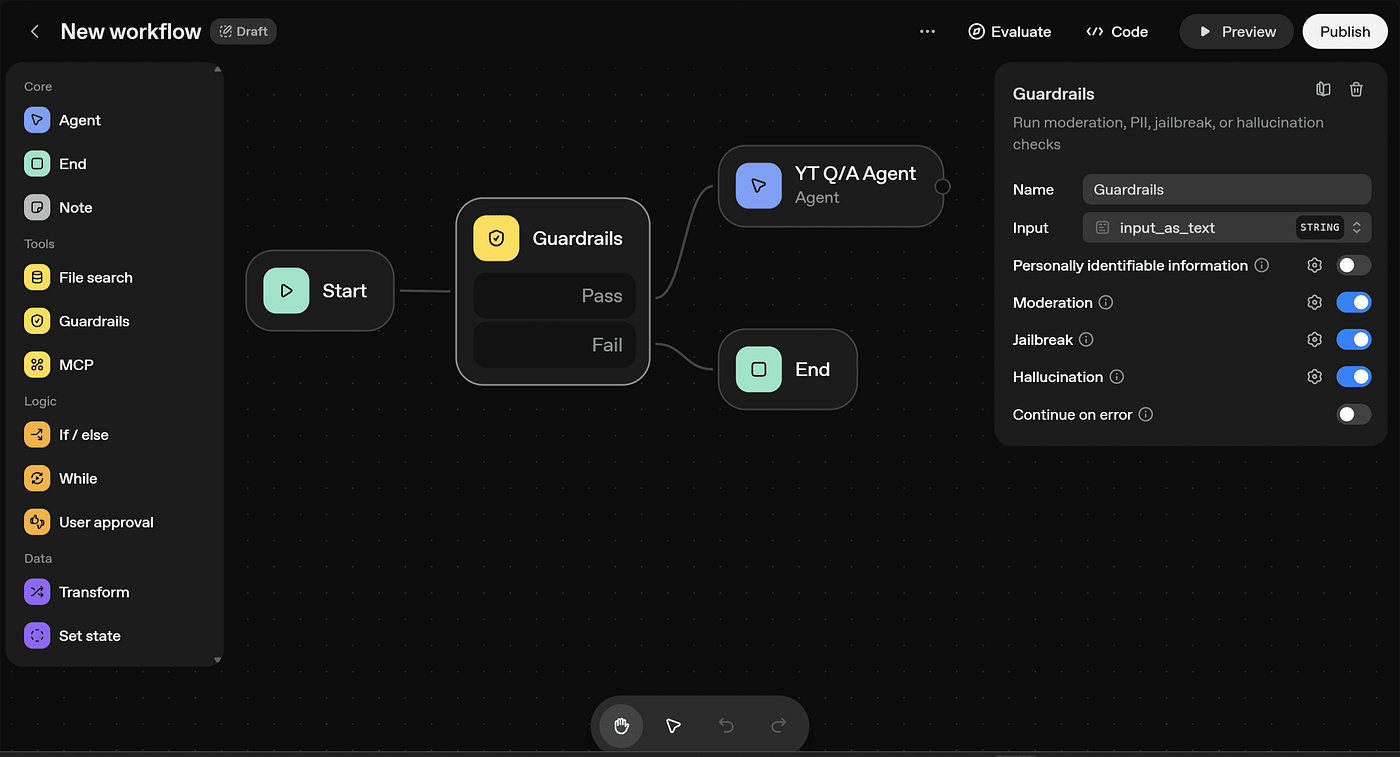
Safety first, right? Especially when dealing with smart AI! That's why “Guardrails” are such a crucial part of the OpenAI Agents SDK (source: https://openai.github.io/openai-agents-python/). Think of Guardrails like the sturdy fences along a mountain road or the helpful rules that keep a playground safe. They are “configurable safety checks” that make sure everything the AI Agent sees and says is appropriate and reliable (source: https://getstream.io/blog/openai-agents-sdk/).
Guardrails are super important for two main things. First, they help with “screening user data” (source: https://platform.openai.com/docs/guides/agents-sdk). This means they can check what people are asking the AI to make sure it's not harmful, inappropriate, or private information that shouldn't be shared. Second, they are vital for “validating agent responses” (source: https://github.com/openai/openai-agents-python). This ensures that whatever the AI Agent says or does is correct, helpful, and sticks to the rules. No weird, unsafe, or untrue answers allowed! It's like having a responsible adult double-checking everything to make sure it’s okay before it goes out (source: https://humanloop.com/blog/openai-agents-sdk). This makes AI applications trustworthy and safe for everyone to use, which is incredibly important as AI becomes more powerful.
Sessions: Remembering What We Said
Have you ever talked to an AI and wished it remembered what you said five minutes ago, or even yesterday? Well, with “Sessions,” that wish comes true! (source: https://openai.github.io/openai-agents-python/). Sessions are all about “automatic management of conversation history” (source: https://platform.openai.com/docs/guides/agents-sdk). This means the SDK automatically keeps track of everything that happens during an Agent's interactions, removing the need for developers to manually handle how the AI remembers past conversations.
Think of it like this: when you chat with a friend, you remember what you talked about last time, right? Sessions give AI Agents that same kind of memory (source: https://github.com/openai/openai-agents-python). This is amazing because it means the Agent can have much more natural and continuous conversations or workflows. It doesn't forget who you are or what you've been discussing, leading to a much smoother and more helpful experience. You won't have to keep repeating yourself, and the AI will build on previous interactions, making it feel much more like talking to a truly intelligent being!
Tracing: Seeing How It All Works
Sometimes, even the smartest AI can get things a little mixed up. When that happens, how do developers figure out what went wrong? With “Tracing“! (source: https://openai.github.io/openai-agents-python/). Tracing is like having a hidden camera and a detailed notebook following your AI Agent every step of the way. It's a “built-in” feature that lets developers “visualize” (see), “debug” (fix mistakes), and “optimize” (make better) what the Agent is doing (source: https://platform.openai.com/docs/guides/agents-sdk).
Imagine your Agent is trying to complete a complex task, and it gets stuck. With Tracing, developers can look at a map of its journey, see every decision it made, every tool it used, and every interaction it had (source: https://github.com/openai/openai-agents-python). This helps them pinpoint exactly where the problem occurred and how to fix it. It also helps with “evaluation” (checking how well the Agent is doing its job) and “model fine-tuning” (making the Agent even smarter over time by teaching it from its experiences) (source: https://humanloop.com/blog/openai-agents-sdk). Tracing is like having x-ray vision for your AI, giving developers the power to understand, improve, and perfect their Agentic applications. It's a vital tool for making sure AI works exactly as intended!
Function Tools: Giving Agents Superpowers
We talked about Agents having “tools,” but what exactly are these tools? With the OpenAI Agents SDK, “any Python function can be converted into a tool” (source: https://platform.openai.com/docs/guides/agents-sdk). This is incredibly powerful! Think of it this way: Python is a programming language that lets you write code to do almost anything on a computer – fetch information from the internet, send messages, crunch numbers, you name it. Now, imagine giving your AI Agent the ability to use any of those custom-made Python functions as its own special skill.
It's like giving your AI Agent a superpower! If you have a Python function that can check the weather, your Agent can now “check the weather.” If you have one that can book a flight, your Agent can “book a flight.” The SDK even helps with “automatic schema generation and validation via the Pydantic library” (source: https://github.com/openai/openai-agents-python). This means it automatically creates a clear instruction manual for the Agent on how to use each tool, making sure it uses them correctly and safely. This feature unlocks an almost endless array of capabilities for AI Agents, allowing them to interact with the digital world in countless ways.
Provider-Agnostic: Freedom to Choose Your AI Brain
Here's another really cool feature that shows how flexible the OpenAI Agents SDK is: it's “Provider-agnostic” (source: https://github.com/openai/openai-agents-python). What does that mean? Well, while OpenAI makes fantastic AI models (like the ones that power ChatGPT), there are many other companies that also create amazing large language models (LLMs). This SDK is designed so that you're not stuck with just OpenAI's models.
Instead, it supports “OpenAI’s APIs and over 100 other LLM providers” (source: https://github.com/openai/openai-agents-python). This is fantastic because it means developers have the “flexibility in backend choice.” They can pick and choose which AI model brain works best for their specific Agent and task, without having to completely rewrite their code. It’s like having a universal remote control that works with almost any TV brand. This freedom allows developers to experiment, find the perfect fit, and ensure their AI Agents are always using the best available technology for the job!
The Master Plan: Design Principles That Guide the SDK
The clever people at OpenAI didn't just throw a bunch of tools together. They had a smart plan, a set of “Design Principles,” that guided how they built the OpenAI Agents SDK. These principles are what make the SDK so special and easy to work with:
- Minimal Primitives, Maximum Power: They aimed for “minimal primitives for steep learning curve reduction while retaining enough power for real-world applications” (source: https://openai.github.io/openai-agents-python/). This means they tried to make the basic building blocks as simple as possible. Imagine learning to build with LEGOs: you start with a few basic bricks, but you can build almost anything with them! This makes it easier for new developers to jump in and start building, but still gives experienced developers all the advanced tools they need for big, important projects (source: https://platform.openai.com/docs/guides/agents-sdk).
- Highly Customizable: The SDK is also “highly customizable” (source: https://openai.github.io/openai-agents-python/). This means that while it “works out-of-the-box” (you can use it right away without much setup), it also “lets you specify exactly what happens at each step” (source: https://platform.openai.com/docs/guides/agents-sdk). So, if you want your Agent to do something in a very specific way, you have the freedom to change and fine-tune every little detail. It's like having a recipe where you can follow it exactly, or you can add your own special ingredients to make it perfect for you!
These principles ensure that the OpenAI Agents SDK is both approachable for beginners and powerful enough for the most ambitious AI projects, a truly remarkable balancing act!
Getting Started: Installation and Setup (It's Easier Than You Think!)
Feeling excited to try it out? The good news is, getting started with the OpenAI Agents SDK is surprisingly simple!
First, you'll need Python installed on your computer, specifically “Python 3.9+” (source: https://github.com/openai/openai-agents-python). Python is a free and easy-to-use programming language that's very popular.
Once you have Python, installing the SDK is a breeze! You just open your computer's command line or terminal and type:
pip install openai-agentsThis command tells your computer to go and fetch all the necessary parts of the SDK and install them (source: https://github.com/openai/openai-agents-python). It's like telling a robot to go pick up a new set of tools for you!
There are also some “optional groups” you can install if you need extra features. For example, if you want your AI Agent to handle voice commands, you can install openai-agents[voice]. If you need special ways for your Agent to remember things across many sessions, you might install openai-agents[redis] (source: https://github.com/openai/openai-agents-python).
Finally, you'll need to “Set your OpenAI API key” (source: https://github.com/openai/openai-agents-python). This is like getting a special secret password from OpenAI that allows your Agent to connect to their powerful AI models. You'll also “configure the environment for development,” which just means setting up your computer so it knows where to find everything (source: https://github.com/openai/openai-agents-python). And just like that, you're ready to start building your very own super-smart AI Agents!
How It All Comes Together: A Typical Workflow (The Agent's Adventure!)
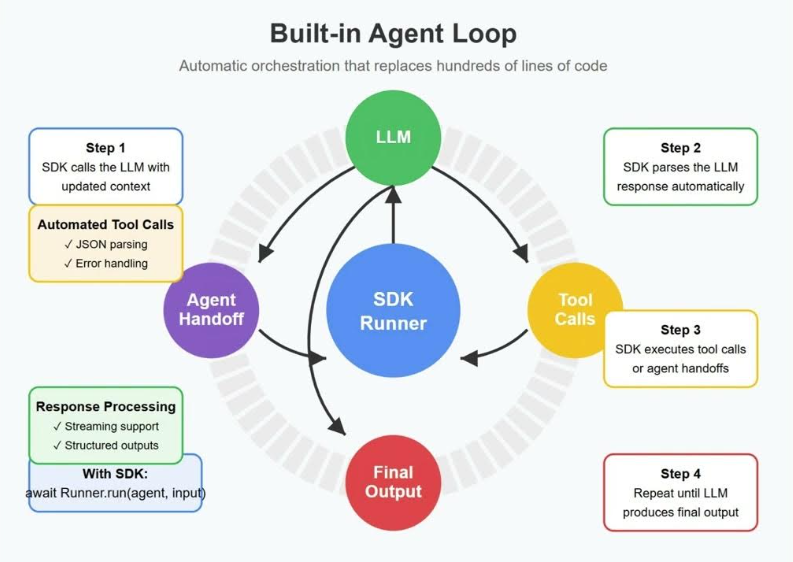
So, you've got the tools installed, and you understand the basic parts. Now, how do you actually build something amazing with the OpenAI Agents SDK? There’s a “typical workflow,” or a set of steps, that developers usually follow (source: https://openai.github.io/openai-agents-python/):
- Define Agents: First, you decide what kind of AI Agents you need (source: https://platform.openai.com/docs/guides/agents-sdk). What instructions will you give them? What specific tasks should they be good at? What “tools” (those Python functions we talked about) will they need to accomplish their goals? You essentially give them their purpose and their skillset (source: https://github.com/openai/openai-agents-python).
- Establish Handoff Logic: If you're building a team of Agents, you'll need to figure out how they pass tasks to each other (source: https://www.siddharthbharath.com/openai-agents-sdk/). Who gets the first job? Who takes over if it's too complicated for the first Agent? This “handoff logic” is like writing the rules for how your AI team collaborates seamlessly.
- Add Guardrails: Next, you put those safety checks in place (source: https://humanloop.com/blog/openai-agents-sdk). You want to make sure your Agents are always acting responsibly, giving appropriate answers, and handling information correctly. This step is about setting the boundaries and rules for safe and reliable operation.
- Use Tracing: As your Agents start working, you’ll want to keep an eye on them. Tracing allows you to watch their decisions and actions, helping you understand if they're doing what you expect and making it easy to fix any problems (source: https://openai.github.io/openai-agents-python/). It's like having a detailed report of everything your Agent does.
- Chain Agents or Tools as Needed: Finally, you connect everything together using “native Python constructs” (source: https://platform.openai.com/docs/guides/agents-sdk). This means using the regular ways Python works to make your Agents use their tools, talk to each other, and complete their multi-step tasks. You're orchestrating a grand performance where each Agent plays its part to perfection.
This step-by-step process ensures that developers can build powerful, reliable, and intelligent AI applications that truly stand out!
A Look Back and Ahead: Comparison to Other Systems
The OpenAI Agents SDK didn't just appear out of nowhere. It stands on the shoulders of previous efforts and learns from other amazing tools in the AI world. Let's see how it compares:
A Successor to the “Swarm”
Did you know OpenAI had a previous experimental system for building Agents? It was called “Swarm” (source: https://openai.github.io/openai-agents-python/). The new OpenAI Agents SDK is its brilliant successor! It takes all the lessons learned from Swarm and makes everything better. Instead of being a rigid system, it offers a “more flexible, code-first approach for workflow logic” (source: https://platform.openai.com/docs/guides/agents-sdk). This means developers have more freedom and direct control using code to design exactly how their Agents behave and interact (source: https://www.siddharthbharath.com/openai-agents-sdk/). It’s like moving from a pre-made toy car to having all the parts and instructions to build your own custom race car – much more powerful and personal!
Standing Beside Other Frameworks
In the exciting world of AI development, there are other famous “frameworks” (toolkits) that also help build smart applications, like LangChain and Llama-Index (source: https://www.datacamp.com/tutorial/openai-agents-sdk-tutorial). The OpenAI Agents SDK is “similar in aim” to these, meaning it also helps developers create intelligent programs (source: https://www.datacamp.com/tutorial/openai-sdk-tutorial). However, it's “streamlined for production use,” meaning it's built to be very robust and efficient for real-world applications (source: https://www.datacamp.com/tutorial/openai-sdk-tutorial).
What makes it stand out is its “deeper integration with OpenAI’s ecosystem and tracing/evaluation tools” (source: https://www.datacamp.com/tutorial/openai-sdk-tutorial). Because it's from OpenAI, it works extra smoothly with all of OpenAI's other incredible technologies, like their powerful language models. Plus, those Tracing and Evaluation tools we talked about are seamlessly woven in, making it a powerful and cohesive choice for developers who want to leverage the full might of OpenAI's advancements.
Real-World Magic: Integration and Usage Examples
So, what kinds of amazing things can you actually build with the OpenAI Agents SDK? The possibilities are truly mind-boggling! Here are just a few examples that show off its power:
- Build Triage-Style Agents: Imagine a customer service system where a smart AI Agent first greets you. This “triage-style agent” can quickly understand your problem and then “route tasks adaptively to specialist agents” (source: https://getstream.io/blog/openai-agents-sdk/). So, if you have a billing question, it sends you to the billing expert Agent. If you have a technical issue, it sends you to the tech support Agent. No more getting bounced around! (source: https://www.siddharthbharath.com/openai-agents-sdk/). It’s like having a super-efficient receptionist who knows exactly who can help you.
- Coordinate Multiple Agents for Complex Processes: Some jobs are just too big for one AI. The SDK lets you “coordinate multiple agents to handle complex, multi-step processes or external tool interactions” (source: https://openai.github.io/openai-agents-python/). For example, one Agent could gather information from the internet, another could summarize it, and a third could use that summary to write an email. Together, they achieve a big goal that no single Agent could do alone! (source: https://www.datacamp.com/tutorial/openai-agents-sdk-tutorial – source: https://www.siddharthbharath.com/openai-agents-sdk/).
- Integrate with Temporal for Long-Running Workflows: For really big projects that take a long time, or tasks that need to be very reliable even if things go wrong, you can “integrate with Temporal for durable execution and long-running workflows” (source: https://openai.github.io/openai-agents-python/)[14]. This ensures that your Agents can work on massive projects, pausing and resuming as needed, without losing their progress. It's like having a reliable project manager who makes sure no step is ever missed, even if there are delays.
These examples just scratch the surface of what's possible. The OpenAI Agents SDK empowers developers to create AI systems that are not just intelligent, but also capable of taking meaningful action in the real world.
Beyond Python: The TypeScript/JavaScript Adventure
While we've talked a lot about Python, the amazing features of the OpenAI Agents SDK aren't limited to just one language! For developers who prefer working with web technologies, there's a “separate SDK” that allows for “similar agent building in TypeScript environments” (source: https://openai.github.io/openai-agents-js/).
This means that whether you're building applications for the desktop or for the web, you can use the same powerful ideas and “primitives” (those basic building blocks) to create your intelligent Agents. It offers the “same primitives and design philosophy” (source: https://openai.github.io/openai-agents-js/). This is fantastic because it ensures that the power of agentic AI can reach an even wider audience of developers, bringing smart, active AI to even more places!
Guiding Your Journey: Business and Technical Support
OpenAI isn't just releasing powerful tools; they're also dedicated to helping everyone use them effectively. They provide “business guides and practical documentation for enterprise adoption and best practices in agent development” (source: https://openai.github.io/openai-agents-python/)[11].
What does this mean? It means that whether you're a big company looking to use AI Agents for your business, or an individual developer wanting to make sure you're building your Agents the best way possible, OpenAI has your back! These guides offer helpful advice, tips, and instructions to ensure that the AI Agents you create are not only smart but also useful, safe, and aligned with good practices. It's like having expert mentors guiding you every step of the way on your AI building adventure!
Your Toolkit at a Glance: Summary Table of Key Primitives
Let's take a quick look back at the amazing building blocks that make up the OpenAI Agents SDK:
| Primitive | Purpose |
|---|---|
| Agents | The core smart programs, powered by LLMs with special tools and instructions. |
| Handoffs | The clever way Agents share tasks and work together as a team. |
| Guardrails | The safety checks that keep inputs and outputs appropriate and reliable. |
| Sessions | The automatic memory system that keeps track of conversations and past interactions. |
| Tracing | The investigative tool that helps developers see, debug, and improve Agent workflows. |
These five powerful “primitives” are the foundation upon which truly intelligent and active AI applications can be built.
Where to Learn More: Additional Resources
The journey of discovery doesn't stop here! If you're eager to learn even more and start building your own AI Agents, there are plenty of excellent resources available:
- Official Documentation and Guides: OpenAI provides amazing “official documentation, quickstart guides, and tutorials” (source: https://openai.github.io/openai-agents-python/). These cover everything from “agent creation” and “tool integration” to creating “structured output” and “workflow orchestration” (source: https://platform.openai.com/docs/guides/agents-sdk). You can find these on OpenAI's own website and also on their GitHub page (source: https://github.com/openai/openai-agents-python).
- Community Blogs and Tutorials: Many brilliant people in the AI community are sharing their knowledge! You can find helpful guides and explanations on sites like DataCamp and Siddharth Bharath's blog (source: https://www.datacamp.com/tutorial/openai-agents-sdk-tutorial – source: https://www.siddharthbharath.com/openai-agents-sdk/).
- Video Tutorials: If you prefer watching and learning, there are also “video tutorials on building agentic applications step-by-step” (source: https://www.youtube.com/watch?v=gFcAfU3V1Zo)[13]. These can be incredibly helpful for seeing the SDK in action!
These resources are your treasure map to mastering the OpenAI Agents SDK and unlocking its full potential.
The Grand Finale: Why the OpenAI Agents SDK Matters!
In essence, the OpenAI Agents SDK is more than just a new piece of software; it's a “monumental leap forward in the world of AI” (source: https://openai.github.io/openai-agents-python/). It gives developers a “modular, extensible framework” (source: https://getstream.io/blog/openai-agents-sdk/). This means it’s like a set of building blocks that can be easily rearranged and expanded, allowing for endless creativity in AI design (source: https://platform.openai.com/docs/guides/agents-sdk).
This incredible toolkit is all about “building agent-driven AI applications” (source: https://github.com/openai/openai-agents-python). It provides all the “essential capabilities for safety, orchestration, and production scalability” (source: https://www.siddharthbharath.com/openai-agents-sdk/). In simpler terms, it makes sure your AI is safe, can handle complex plans, and is strong enough for real-world use. It achieves all this while “emphasizing simplicity and flexibility for both beginner and advanced developers” (source: https://humanloop.com/blog/openai-agents-sdk).
The thrill of this moment is that we are witnessing the democratization of advanced AI capabilities. The OpenAI Agents SDK isn't just about creating smarter AI; it's about creating AI that can do. Imagine a world where AI doesn't just answer questions, but actively helps solve problems, manages tasks, and collaborates intelligently. From automating complex business processes to powering the next generation of smart assistants, the possibilities are truly limitless (source: https://openai.github.io/openai-agents-python/)[13][14].
This is a monumental step towards a future where AI Agents are not just futuristic concepts, but helpful, reliable partners in our digital world. The OpenAI Agents SDK is here, and it’s inviting everyone to join the adventure of building tomorrow’s most incredible AI applications. Get ready for a thrilling ride!
Frequently Asked Questions
Here are some common questions about the OpenAI Agents SDK:
- What is the primary purpose of the OpenAI Agents SDK?The OpenAI Agents SDK is an open-source framework designed to help developers build “agentic AI applications” that can act and make decisions to complete complex tasks autonomously, leveraging large language models (LLMs) and various tools.
- What are the key components or “primitives” of the SDK?The core primitives include Agents (the intelligent programs), Handoffs (for task delegation between Agents), Guardrails (for safety and validation), Sessions (for conversation history management), and Tracing (for visualization and debugging of Agent workflows).
- Can I use other LLMs besides OpenAI's with this SDK?Yes! The SDK is “Provider-agnostic” and supports OpenAI’s APIs as well as over 100 other LLM providers, giving developers flexibility to choose the best AI model for their specific needs.
- What programming languages does the OpenAI Agents SDK support?Primarily built with Python, the SDK also has a separate version for TypeScript/JavaScript, allowing a wider range of developers to build agentic AI applications using their preferred web technologies.
- How does the SDK ensure the safety of AI Agents?The SDK incorporates “Guardrails,” which are configurable safety checks for screening user data and validating agent responses, ensuring that the AI Agents operate within appropriate and reliable boundaries.