

The AI Revolution is Here: How Does Agentic AI Differ From Traditional Automation? A Comprehensive Guide
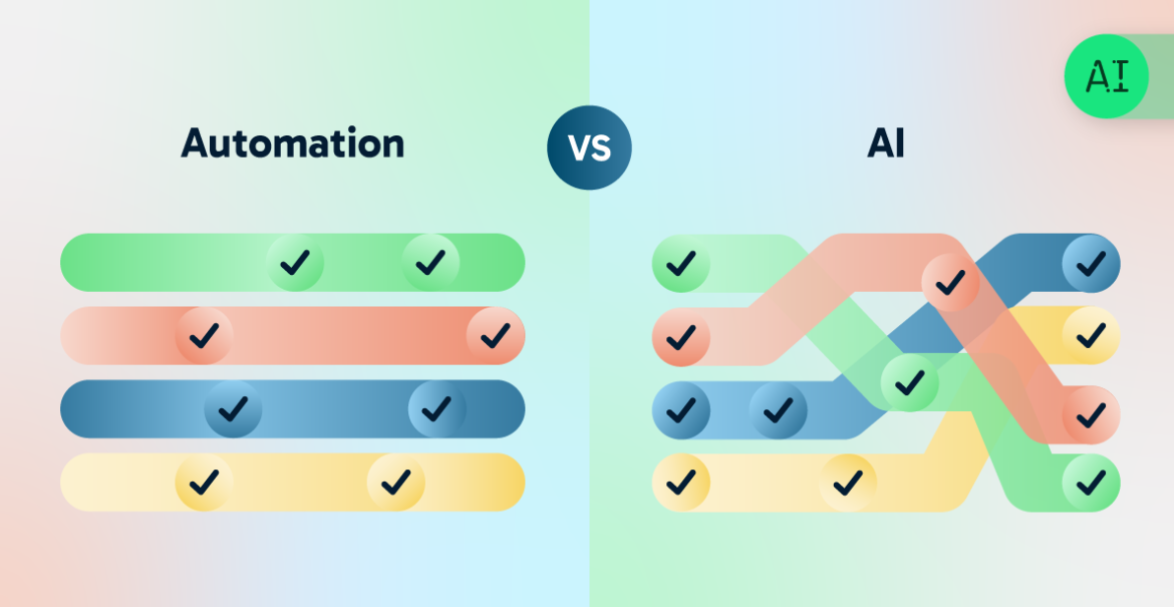
How Does Agentic AI Differ From Traditional Automation?
Estimated reading time: 12 minutes
Key Takeaways
-
- Agentic AI represents a paradigm shift from traditional automation by operating with autonomous, goal-based decision-making.
-
- Unlike traditional automation's rigid “if this, then that” rules, Agentic AI can interpret objectives, plan, and adapt dynamically.
-
- Traditional automation relies on deterministic scripts and breaks easily when environments change, whereas Agentic AI learns and evolves through feedback and context analysis.
-
- Agentic AI initiates actions proactively and handles exceptions without constant human oversight, fundamentally changing the human-AI relationship.
- This technology expands problem-solving scope from simple tasks to complex, multi-step projects involving uncertainty and adaptation.
Table of contents
The Core Difference: Following a Recipe vs. Inventing a New Dish
To understand the giant leap from traditional automation to Agentic AI, let's start with a fun analogy: cooking in the kitchen.
Traditional Automation: The Perfect Recipe Follower
Imagine you have a cookbook with a very simple recipe for making toast. The instructions are crystal clear:
-
- Take one slice of bread.
- Put it in the toaster.
- Press the “start” button.
- Wait until it pops up.
Traditional automation is like a robot that can only follow this exact recipe. It is built on deterministic, predefined rules or scripts that trigger when specific conditions occur. Think of these as “if this, then that” commands. If you press the “start” button, then the toaster heats up. It's incredibly reliable and great for simple, repeating jobs. A factory assembly line, a scheduled daily backup of your computer, or an automatic email reply that says “I'm out of the office” are all perfect examples of traditional automation.
But what happens if something changes? What if you run out of bread? Or what if the toaster breaks? The recipe-following robot would be stuck. It can't think for itself. It would just stop, unable to complete its task because the exact conditions of its recipe weren't met. It’s a fantastic follower, but a terrible problem-solver.
Agentic AI: The Creative Chef
Now, let's imagine you don't give the robot a recipe. Instead, you give it a goal: “Make me a delicious breakfast.”
This is where Agentic AI shines. An Agentic AI is built around autonomous, goal-directed agents that can interpret objectives, plan multi-step actions, choose among tools, and adjust behavior as the environment changes. This is our creative chef!
The Agentic AI chef receives the goal—”delicious breakfast.” It doesn't have a rigid script. Instead, it starts thinking and planning.
-
- First, it assesses the situation: It scans the kitchen. It sees bread, eggs, milk, and a banana. It also sees a toaster, a frying pan, and a blender.
-
- Next, it plans a course of action: It thinks, “I could make toast. Or I could make scrambled eggs. Or maybe a banana smoothie would be nice.” It weighs the options.
-
- Then, it adapts to problems: It checks the toaster and realizes the power is out! The recipe-following robot would have given up. But our AI chef simply adapts. It says, “Okay, the toaster is out. No problem. I'll use the frying pan to make French toast instead, since I have bread, eggs, and milk.”
- Finally, it achieves the goal: It whips up some amazing French toast and serves you a delicious breakfast.
The key difference is simple: traditional automation follows instructions, while Agentic AI pursues goals. One needs a perfect, unchanging world to work, while the other thrives in our messy, unpredictable reality.
Autonomy and Initiative: The Remote-Controlled Car vs. The Space Explorer
Another huge difference between these two technologies is who is in charge. Who kicks things off and makes the decisions along the way?
Traditional Automation: Waiting for the “Go” Signal
Think of traditional automation as a remote-controlled car. It’s fast and fun, but it does absolutely nothing until you pick up the controller and press a button. It has zero initiative. Traditional automation does not initiate work on its own beyond simple triggers; it runs when scheduled or when a precise event occurs.
Your car's cruise control is a form of automation. It keeps your car at a steady speed, but only after you turn it on and set the speed. An automatic coffee maker starts brewing at 7 AM, but only because you scheduled it the night before.
These systems are passive. They are powerful tools, but they are always waiting for a human or a pre-set timer to tell them what to do. They can't look at a situation and decide, “Now seems like a good time to start this task.” Furthermore, it cannot reinterpret or reformulate goals. If you set the coffee machine for 7 AM, it will never decide to brew it at 6:45 AM just because it senses you woke up early.
Agentic AI: The Self-Starting Adventurer
Agentic AI, on the other hand, is like a robotic rover exploring Mars. Scientists on Earth don't control its every move with a joystick. That would take too long! Instead, they give it a high-level goal, like “Go to that interesting-looking rock and analyze it.”
The rover then takes over completely. Agentic AI can initiate tasks, choose when and how to act to achieve a target outcome, and continue operating over time. The Mars rover decides for itself how to get to the rock. It plans its own path, navigates around craters and obstacles, and decides which tools to use for the analysis.
This is true autonomy. An Agentic AI working as your personal assistant wouldn't just file an email when it arrives. It might notice you have a meeting with “Bob” in an hour. On its own initiative, it could search your files for the documents related to your last project with Bob, summarize them, and present them to you so you're prepared for the meeting. You never told it to do that. It saw a goal—help you be prepared for your meeting—and it took the initiative to achieve it. It can also handle exceptions and edge cases on its own instead of immediately escalating to humans. If a file is missing, it won't just stop; it might search for it in an archived folder or send a polite request to a colleague for the document.
Learning and Growing: The Brittle Robot vs. The Master Student
The world is constantly changing. What happens when our technology faces something new? This is where we see one of the most exciting and important differences of all.
Traditional Automation: Strong but Brittle
Traditional automation is strong, but it's also brittle. Think of it like something made of glass. It works perfectly under specific conditions, but the moment something changes, it shatters. Traditional automation is brittle: when data formats, business rules, or external systems change, developers must manually update scripts or workflows.
Imagine a simple automated program designed to copy information from a form into a spreadsheet. It’s told to look for a box labeled “First Name” and a box labeled “Last Name.” For years, it works perfectly. But one day, the company updates the form, and the boxes are now labeled “Given Name” and “Family Name.”
The automated program would break instantly. It would be completely lost. It doesn't understand the concept of a name; it only knows the exact labels it was told to look for. A human programmer would have to go in and manually update the code to look for the new labels. Furthermore, the system does not improve from experience. It will make the same mistake a million times until a human fixes it.
Agentic AI: The Constant Learner
Agentic AI is designed from the ground up to learn and adapt. It’s like a star student who doesn't just memorize facts but learns the concepts behind them. Agentic AI incorporates learning and feedback loops, allowing it to refine its strategies, adapt to new data patterns, and re-plan in real time.
Let’s go back to our form-filling example. An Agentic AI would also be told to find the names. But when it sees the new form with “Given Name” and “Family Name,” it wouldn't just give up. It would use its “brain” to reason. It might think:
-
- “The form has changed.”
-
- “These new labels are in the same place the old name labels used to be.”
-
- “The information people are typing into these boxes, like ‘Sarah' and ‘Smith,' looks like names.”
- “I'm pretty sure ‘Given Name' means the same thing as ‘First Name.' I'll try it and see if it works.”
When it successfully copies the information, it learns! It updates its own understanding. The next time it sees “Given Name,” it will know exactly what to do. This makes Agentic AI better suited for dynamic, uncertain environments. It doesn't break when the world changes; it learns from it. It gets smarter and more efficient with every task it completes, just like a person gaining experience at a new job.
Scope of Work: A Simple Tool vs. A Project Mastermind
What kind of jobs can these different technologies handle? Their capabilities are worlds apart, and this defines the kind of problems we can solve with them.
Traditional Automation: The Specialist in Simple Chores
Traditional automation is a master of the simple, repetitive task. It is narrow, focusing on repeatable, well-structured tasks such as simple data transfers, form processing, or routine system operations. It has very limited context-awareness.
Think of the tools in a toolbox. You have a hammer, a screwdriver, and a wrench. Each one is incredibly good at its one specific job. The hammer is fantastic for nails but terrible for screws. You wouldn't ask a hammer to build a whole house; you only use it for one small part of the job.
This is traditional automation. A script that renames 1,000 photos is a great time-saver. A system that automatically sends a receipt after a purchase is very efficient. But these tools don't understand the bigger picture. The photo-renaming script doesn't know why you're renaming the photos, and the receipt-sender doesn't know what your overall business goals are. They just perform their one simple function perfectly.
Agentic AI: The Conductor of a Grand Orchestra
Agentic AI is not just one tool; it’s the entire toolbox, plus the master craftsperson who knows how to use every tool to build something amazing. It can handle big, messy, complex projects from start to finish. Agentic AI uses techniques like probabilistic reasoning and contextual analysis to handle ambiguity, coordinate multi-step processes end-to-end, and make tradeoff decisions.
Let's break that down.
-
- Contextual Analysis: This means it understands the whole story. If you ask it to “book my trip to the conference in Miami”, it doesn't just book a random flight. It checks your calendar to see when the conference starts and ends. It looks at your past travel to see if you prefer window or aisle seats. It checks your hotel loyalty programs to find the best deal. It understands the full context of your request.
-
- Probabilistic Reasoning: This is a fancy way of saying it can make smart guesses. If a client's email just says, “Let's connect next week,” the AI can look at your calendar, see you're free on Tuesday afternoon, and suggest a specific time, rather than just asking you what to do. It plays the odds to find the most likely best solution.
-
-
- Book the flights.
- oordinate Multi-Step Processes: This is its superpower. Like a project manager, it can juggle many different tasks at once to achieve a single goal. For our Miami trip example, the Agentic AI would:
- Add all the confirmation details to your calendar.
- Check the weather in Miami and suggest what clothes to pack.
Book a hotel near the conference center.Book a rental car.
- Find top-rated restaurants near your hotel for dinner.
-
No single, simple tool could do all of that. It takes a mastermind that can see the big picture and manage a long chain of interconnected tasks.
Our New Role: From Puppet Master to Team Captain
Perhaps the most profound difference is how Agentic AI changes our relationship with technology. We are no longer just users or programmers; we are becoming leaders and collaborators.
With Traditional Automation: We Are the Micromanagers
In the world of traditional automation, humans are required to design detailed workflows, handle exceptions, and periodically reconfigure the system as requirements change. We are the puppet masters, and we have to pull every single string.
We have to think of every possible problem in advance and write a rule for it. If we forget a rule, the system breaks and we have to rush in to fix it. This approach mainly reduces manual effort in stable processes, but it doesn't free us from the complex work of thinking, planning, and problem-solving. We spend our time managing the details of the machine.
With Agentic AI: We Are the Visionaries
Agentic AI completely flips this relationship on its head. It shifts human roles toward defining high-level goals, constraints, and guardrails while the agents manage orchestration, exception handling, and continuous optimization.
We move from being the micromanagers to being the Team Captains. We don't tell the players exactly how to run every step of the play. Instead, we give them the goal (“Win the game!”), explain the rules (“Don't go out of bounds”), and share the overall strategy (“Focus on a strong defense”). Then, we trust our smart, autonomous players—the AI agents—to execute the plan, adapting to the other team's moves in real-time.
Our job becomes more creative and strategic. We get to focus on the “what” and the “why,” while the AI handles the “how.” This improves responsiveness, scalability, and long-term ROI in complex operations, because the AI agents can work 24/7, managing thousands of tasks at once and constantly getting smarter, allowing humans to focus on the big ideas that will shape our future.
A New Dawn for a Smarter World
So, how does agentic ai differ from traditional automation?
In the simplest terms, it’s the difference between a tool and a teammate.
Traditional automation gave us tools—powerful, reliable, and fantastic for making simple, repetitive work disappear. Agentic AI gives us teammates—autonomous, adaptable, and brilliant partners capable of tackling complex, goal-oriented projects.
| Feature | Traditional Automation | Agentic AI |
|---|---|---|
| Core Idea | Follows Pre-Written Rules | Achieves Open-Ended Goals |
| Initiative | Passive (Waits for a trigger) | Proactive (Takes initiative) |
| Adaptability | Brittle (Breaks with change) | Resilient (Learns and adapts) |
| Task Scope | Narrow & Simple | Broad & Complex |
| Human Role | Micromanager (Designs every step) | Visionary (Sets the goals) |
This isn't just a small upgrade; it's a whole new way of working with technology. We are at the beginning of an incredible new era, one where we can solve bigger problems, unlock more creativity, and achieve more than we ever thought possible. The future isn't about humans being replaced by machines. It's about humans being amplified by them.
The next time you think about the future of AI, don’t just picture a faster robot. Picture a tireless problem-solver, a creative partner, and a smart assistant dedicated to helping you achieve your biggest goals. That is the promise of Agentic AI.
What amazing goal would you give your first AI agent? The possibilities are endless.
Frequently Asked Questions
What exactly is Agentic AI?
Agentic AI refers to autonomous, goal-driven artificial intelligence systems that independently plan, make decisions, and execute tasks without strict human direction, often adapting to changing environments. For more info, see OpenAI’s research on Agentic AI.
How is traditional automation limited compared to Agentic AI?
Traditional automation strictly follows pre-programmed rules and cannot handle unexpected changes or learn from experience. It lacks the autonomy to initiate or change strategies based on new data.
Can Agentic AI replace humans?
No, Agentic AI is designed to augment human capabilities by automating complex tasks and providing cognitive assistance. Humans still define goals, ethical boundaries, and provide strategic oversight.
What industries can benefit most from Agentic AI?
Industries involving complex, adaptive tasks such as healthcare, logistics, finance, research, and customer service stand to gain significantly from Agentic AI. It helps manage multi-step, uncertain workflows efficiently.
Where can I learn more about the differences between Agentic AI and traditional automation?
Great resources include academic papers on Agentic AI, leading AI research organizations' blogs like OpenAI, and technology news sites that explore AI advancements comprehensively.