

Unveiling GitHub Spec Kit: The Secret Weapon for AI-Powered Coding!
Estimated reading time: 15 minutes
Key Takeaways
- _GitHub Spec Kit_ is an _open-source toolkit_ developed by GitHub for _spec-driven development_.
- It bridges the gap between human intentions and AI-generated code, ensuring _alignment_ with project goals.
- Core concepts include _Intent-Driven Development_, _Machine-Readable Specs_ (using Markdown), and _Seamless Integration_ with AI coding assistants.
- The toolkit enforces _Version Control_ by storing plans in a `.specify` directory, fostering transparency and traceability.
- It outlines a clear workflow: _Specify_, _Plan_, _Tasks_, and _Implement_, making development _iterative_ and flexible.
- Key benefits include _perfect alignment_, _enhanced collaboration_, _adaptability_, and _tool-agnostic_ integration.
- Tens of thousands of developers have already adopted Spec Kit, highlighting its growing impact on _AI-powered software development_.
Table of contents
- GitHub Spec Kit: The Revolutionary Tool Changing How We Build Software with AI!
- Key Takeaways
- The Big Picture: What is GitHub Spec Kit All About?
- Unlocking the Secrets: Core Concepts of Spec Kit
- Your Project's Adventure: Structure and Workflow with Spec Kit
- Your First Steps: Getting Started with GitHub Spec Kit!
- The Superpowers of Spec Kit: Key Benefits!
- A Growing Family: Community and Adoption of Spec Kit!
- Under the Hood: Technical Details Made Simple!
- A New Era of Coding: Spec Kit vs. Traditional Development!
- The Future is Here: A Thrilling Conclusion!
- Frequently Asked Questions
Imagine you're trying to build a magnificent treehouse. You have a super-smart robot helper, an amazing AI, who can build things lightning fast. But sometimes, this robot, despite its brilliance, builds something that's not quite what you had in mind. Maybe it's a fantastic treehouse, but it has a slide where you wanted a swing, or it’s painted green when you dreamed of blue. This is a bit like the challenge many smart computer wizards (we call them developers!) face when they use awesome AI tools to help them write computer code. Sometimes, the AI-generated code, while clever, doesn't quite match the developer's exact wishes or the grand plan for the project. But guess what? A brand new, super exciting toolkit called GitHub Spec Kit has arrived to save the day!
GitHub Spec Kit is making waves across the world of AI-assisted software development, promising to bridge the gap between human dreams and AI's rapid creation. Get ready to discover how this incredible tool, developed by the clever minds at GitHub, is revolutionizing how we create software, making coding clearer, more organized, and much, much more exciting! It's all about something really smart called “spec-driven development,” and it’s going to make sure that when you use AI to build your digital dreams, they come out exactly as you imagined!
The Big Picture: What is GitHub Spec Kit All About?
So, what exactly is this amazing GitHub Spec Kit? Think of it as a super-powered planner and guide for building digital things. It's an open-source toolkit, which means many brilliant people can work on it and make it better, all developed by the famous GitHub team. Its main job is to help with something called spec-driven development—a fancy way of saying we should always have super clear and well-organized plans (specifications) ready before we even start building something with code, especially when awesome AI helpers are involved.
Why is this so important? Well, as we talked about with our treehouse robot, sometimes AI coding assistants, like GitHub Copilot or Gemini CLI, can create code that doesn’t quite fit what the developer truly wanted or what the project actually needs. It's not the AI's fault; it just needs a clearer picture! This is where GitHub Spec Kit swoops in like a superhero. It gives us a special way to capture, organize, and follow these software plans in a way that both humans and super-smart AI can easily understand. It's like having a universal translator for your dreams, making sure your AI helper builds exactly what’s in your head!
This kit is designed to tackle a really common problem in today's fast-paced coding world. With AI tools becoming so powerful, they can write code incredibly fast. But speed isn't everything if the code isn't exactly right. Imagine asking your robot to bake a chocolate cake, but without a clear recipe, it bakes a carrot cake instead. Both are cakes, but not what you wanted! GitHub Spec Kit provides that perfect recipe, that precise blueprint, that ensures the AI understands every single detail, making sure the final code is not just good, but perfectly aligned with the developer's original vision and the project's goals. This isn't just about making coding easier; it's about making it smarter and much more efficient!
Unlocking the Secrets: Core Concepts of Spec Kit
To truly understand how GitHub Spec Kit performs its magic, let's explore its core ideas. These are the foundations that make this toolkit so powerful and exciting!
Intent-Driven Development: What You Want, Before How You Get It!
This is one of the coolest ideas behind Spec Kit. It means that before you even think about how you're going to build something, you first write down what you want to build. Think of it like this: if you're planning a birthday party, you first decide what kind of party you want (a superhero party, a pirate party, etc.) and what games you want to play. Only after that do you figure out how to get the costumes or how to set up the games.
In the world of software, this means spending time clearly describing the goals, the features, and what the user should experience. This makes sure everyone, including your AI coding assistants, understands the purpose of the software. It’s like moving the instruction manual from being something you write after you’ve built something, to being the very first thing you create. This way, the documentation (the instructions) becomes the heart of the whole building process, not just an afterthought. It ensures that every step taken, every line of code written, is always pointed towards that clear, initial intention. This focus on “intent” means less confusion, fewer mistakes, and a much smoother journey from idea to finished product.
Machine-Readable Specs: Speaking the Language of Humans and Robots!
Another brilliant idea of GitHub Spec Kit is how it handles these plans, or “specifications.” They aren't written in a secret code that only super-smart computer scientists can understand. Nope! These specifications are written in simple Markdown files. If you've ever used a simple text editor or written notes on your computer, you've probably used something similar. Markdown is a super easy way to write clear, well-organized text that looks good.
Why is Markdown so great for Spec Kit? Because it's easily readable by both humans and AI agents! Imagine having a recipe that you can read, and your robot chef can read and understand perfectly too. That's exactly what Markdown does for Spec Kit. It means developers can quickly understand the plans, and the AI coding tools can also “read” and process these plans to generate code that directly matches the instructions. This shared language removes a huge barrier, making communication between human creativity and AI execution incredibly smooth and effective. It's truly a leap forward in collaborative development!
Seamless Integration with AI Coding Assistants: Your AI, On Your Team!
This is where GitHub Spec Kit truly shines in the age of AI. It doesn't ask you to ditch your favorite AI coding helpers; instead, it makes them even smarter! Spec Kit works hand-in-hand with many of the big-name AI coding tools you might already know, or will soon know. We're talking about amazing tools like GitHub Copilot, Claude Code, Gemini CLI, Cursor, Windsurf, and lots of others.
The magic here is that Spec Kit gives these AI tools the super clear, detailed plans they need. Instead of the AI guessing what you want, it gets precise instructions from your specifications. This allows these powerful AI assistants to generate code that doesn't just work, but actually sticks to the rules and goals you've carefully laid out. It's like giving your robot chef not just any recipe, but your exact recipe, so it bakes your perfect chocolate cake every time! This deep integration ensures that the AI becomes a true, reliable teammate, working from the same playbook as you, leading to incredibly accurate and useful code generation.
Version Control: Keeping Track of Every Big Idea!
Think about writing a story. You might write a draft, then change a paragraph, then add a new character, then revise the ending. It's super helpful to be able to see all the different versions of your story, right? To go back if you changed your mind, or to see how your story grew. GitHub Spec Kit does this for your software plans using something called “version control.”
All the important planning files for your project are kept in a special folder called .specify. Because these files are stored in a place that's designed for version control (like GitHub itself!), every single change you make to your plans is tracked. This means you can see how your project's ideas and goals have grown and changed over time. It's like having a perfect history book of your project's journey! If you ever need to look back at an old plan, or see who suggested a change, it's all there. This transparency and traceability are incredibly valuable for teams, ensuring everyone understands the “why” behind every decision and how the project's intention has evolved. It's a fantastic way to keep everyone, and every AI, perfectly aligned!
Your Project's Adventure: Structure and Workflow with Spec Kit
Now that we know the core ideas, let's explore how GitHub Spec Kit organizes your project and guides you through its exciting workflow. Think of it as the map and compass for your software-building adventure!
The `.specify` Directory: Your Project's Brain Trust
Every project that uses GitHub Spec Kit has a special folder at its heart: the `.specify` directory. This isn't just any folder; it's where all the brilliant ideas, plans, and instructions for your software live. Inside, you'll find a few key Markdown files, each with its own special job:
spec.md– The Dream and the Goal: This is like the big dream board for your project. Here, you write down the grand goals, what your software must be able to do, any challenges you need to overcome, and, most importantly, who will use it and what they need. It’s the “what” and the “why” of your whole adventure, written down clearly for everyone to see and understand. This file ensures that everyone on the team, including the AI, understands the big picture before diving into the tiny details. It helps prevent getting lost in the weeds and keeps the focus on the ultimate vision.plan.md– The Map to Treasure: Once you have your dream (in `spec.md`), you need a map to get there! The `plan.md` file is exactly that. It describes the technical way you’re going to build your dream. This means talking about how the parts of your software will fit together (its “architecture”), how information will flow through it, what special tools or libraries you'll use, and what other things your software might depend on to work correctly. It's the “how” you'll achieve the “what.” This detailed plan guides both human developers and AI assistants, giving them a clear path to follow and helping them understand the bigger technical strategy.tasks/– Little Missions to Complete: Imagine your big plan is a long journey. You wouldn't try to walk the whole way in one giant leap, right? You break it down into smaller, manageable walks! That's what the `tasks/` folder is for. Inside, you'll find individual files, each describing a small, actionable piece of work. Each task has enough information and context for either a human developer or an AI assistant to complete it without needing to ask a million questions. These are the individual missions that, when all completed, will build your software piece by piece. This breaking down into smaller, defined tasks makes complex projects feel much less daunting and allows for efficient progress.constitution.md(Optional) – The Project's Rulebook: Sometimes, a project has special rules or important principles that everyone needs to follow. The `constitution.md` file is a place for these optional guidelines. It could be about how code should look, or how the team should work together. It's like having a friendly rulebook to ensure everyone is playing by the same, helpful rules! While optional, this file can be incredibly useful for maintaining consistency and clarity within larger teams.
The Workflow Phases: Your Step-by-Step Software Building Journey!
With these special files in place, GitHub Spec Kit guides you through an exciting, step-by-step journey for building your software. These are the main “phases” of the Spec Kit workflow:
- Specify: The Vision Begins!
This is where your adventure truly starts. In this phase, you focus on defining what your project should do and, just as importantly, why it needs to do it. All of these big ideas, requirements, and user needs are carefully written down and captured in yourspec.mdfile. It's like setting the destination and purpose of your journey. This phase ensures that the foundation of your project is crystal clear, preventing any misunderstandings down the line. - Plan: Drawing the Map!
Once you have your clear vision, the next step is to figure out the technical way to achieve it. This is the planning phase. Here, you translate all those intentions and requirements from `spec.md` into a detailed technical approach. You think about the software's structure, how data will move, and what tools you'll use. All of this is carefully documented in yourplan.mdfile. This is like drawing a detailed map, complete with routes and landmarks, that will guide you to your destination. - Tasks: Breaking Down the Journey!
Now that you have your overall plan, it's time to break it down into smaller, easier-to-handle pieces. This phase involves creating those self-contained units of work we talked about earlier. Each task is clearly described in its own file under thetasks/directory. Think of these as individual legs of your journey, each with its own clear objective. These small, manageable tasks make the entire project feel less overwhelming and much more achievable. - Implement: Building with Your AI Team!
This is the moment of creation! With your clear specifications, detailed plan, and broken-down tasks all ready, you can now use your amazing AI coding tools to generate and review the actual computer code. The AI uses all the information in your `spec.md`, `plan.md`, and `tasks/` files to create code that perfectly matches your instructions. It's like giving your robot chef the perfect recipe and having it bake your cake with incredible speed and accuracy!
What's super cool is that you can kick off these phases in a few ways. You can use simple “slash commands” (like `/specify` or `/plan`) in many supported coding agents, which is like giving a quick command to your AI helper. Or, you can simply open and edit the Markdown files directly.
And here's the truly amazing part: this workflow is like a living, breathing process, it's iterative! This means it's super easy to change and improve things. If your project's needs change (and they often do!), you can simply update your spec.md, plan.md, or tasks/ files. Then, your AI agents can regenerate the code to match these new changes. This keeps your project always aligned with your intentions, no matter how much it grows and evolves. It's truly a flexible and powerful way to build software!
Your First Steps: Getting Started with GitHub Spec Kit!
Ready to jump into the exciting world of spec-driven development with GitHub Spec Kit? Here's how you can begin your own adventure and start creating software with amazing clarity and AI assistance!
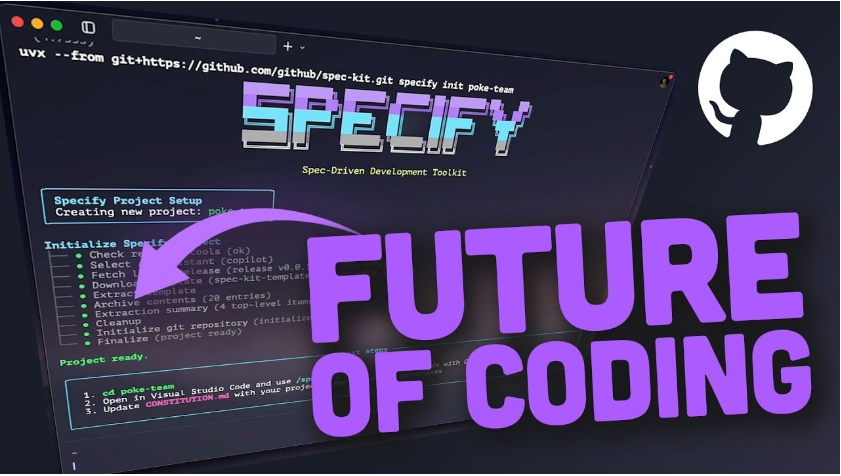
- The Super Helpful CLI Tool: The easiest way to get started is by using something called the Specify CLI. CLI stands for “Command Line Interface,” and it's a special tool you can use by typing simple commands into your computer. This CLI is like a magic wand! It helps you set up your `.specify` directory with ready-to-use templates for all the important files we talked about (`spec.md`, `plan.md`, etc.). Even better, it creates special “prompt files” for your AI coding agents, which are like super clear instructions that help the AI understand exactly what to do. It's the quickest path to getting your project up and running with Spec Kit.
- Templates: Your Ready-Made Guides: If you prefer to do things a bit more hands-on, you can also manage your templates manually. You can simply download these helpful starting files from the main GitHub Spec Kit repository on GitHub and place them directly into your project folder. These templates are fantastic because they give you a clear structure to follow, making sure you don't miss any important parts of your plan.
- Learning Resources: Become a Spec Kit Master!
For those who love to learn deeply, there are fantastic resources available. LinkedIn Learning offers a special course that teaches you all about spec-driven development using GitHub Spec Kit. This is a great way to get expert guidance. Plus, GitHub’s official documentation (like instruction manuals) and its community resources (where other developers share tips) provide even more helpful guidance. You'll have all the tools and knowledge you need to become a true Spec Kit wizard!
The Superpowers of Spec Kit: Key Benefits!
Why is GitHub Spec Kit such a big deal? Because it brings a host of incredible benefits that make software development clearer, more collaborative, and much more fun! Get ready to discover the superpowers it gives to every developer and team.
- Perfect Alignment: No More Guessing Games!
One of the biggest worries with AI-generated code is whether it actually matches what the developer truly intended. But with Spec Kit, that worry disappears! It makes sure that the code created by AI perfectly matches the developer's exact wishes and vision. By providing a super clear, structured plan, the AI has all the context it needs to get it right. It's like giving your robot helper a blueprint that leaves no room for mistakes, ensuring the final product is always exactly what you dreamed of! - Teamwork Makes the Dream Work: Enhanced Collaboration!
Building software is almost always a team effort. GitHub Spec Kit makes this teamwork even better! It creates a single, crystal-clear source of truth in those version-controlled spec files. This means everyone on the team—human developers and AI agents alike—is working from the same playbook. It makes communication smoother, reduces misunderstandings, and helps everyone stay on the same page. Imagine a whole orchestra playing a symphony, with every musician and even the automatic instruments following the exact same, perfect sheet music. That's the power of collaboration with Spec Kit! - Super Adaptable: Ready for Anything!
Projects rarely stay exactly the same from start to finish. Requirements can change, new ideas pop up, and sometimes you need to shift direction. GitHub Spec Kit is built for this! Its iterative process means it’s super easy to update your plans and refine your project as things change. This adaptability is fantastic because it means your software can grow and evolve without causing huge headaches. It's like having a flexible plan that can bend and change without breaking, always moving towards the best possible outcome. - Works With Your Favorite Tools: Tool Agnostic Power!
You already have your favorite tools and coding environments, right? Well, GitHub Spec Kit is designed to work seamlessly with them! It doesn't force you to learn a whole new set of tools; instead, it integrates beautifully with the coding environment and AI tools you're already comfortable using. This means you can get all the amazing benefits of spec-driven development without having to completely change your workflow. It's like adding a powerful upgrade to your existing setup, making everything you already use even better and more efficient!
A Growing Family: Community and Adoption of Spec Kit!
The excitement around GitHub Spec Kit is palpable, and it's not just a small group of developers giving it a try. According to GitHub itself, tens of thousands of developers have already embraced and adopted Spec Kit! This is a huge number and shows just how much interest and enthusiasm there is for this new way of developing software with AI. It clearly indicates that developers are seeing the real value and power that Spec Kit brings to their projects.
The fact that so many developers are quickly adopting this toolkit means that it’s rapidly becoming a key player in the exciting world of AI-powered development. More and more people are discovering how it helps them build better, clearer, and more aligned software. And here's another fantastic piece of news: the toolkit is open source! This means its code is openly available for anyone to see, use, and even improve upon. This open-source nature encourages developers from all over the world to contribute their own ideas and extensions, making Spec Kit even more powerful and versatile for the entire developer community. It’s truly a collaborative effort that’s building the future of coding!
Under the Hood: Technical Details Made Simple!
Even though GitHub Spec Kit sounds super advanced, some of its cleverest tricks are based on simple, smart ideas. Let’s peek under the hood at some of its technical details!
- Markdown-Based: Simple Yet Powerful!
We've mentioned this before, but it's worth highlighting again: all the important files for your specifications, plans, and tasks are written using Markdown. Why is this a “technical detail”? Because Markdown is not only easy for humans to read, but it's also incredibly easy for computers to process. This makes it a perfect choice for integrating with version control systems (like GitHub itself, which loves Markdown!). It ensures that your plans are always clear, consistent, and ready for both human eyes and AI brains. - AI Prompt Generation: Clear Instructions for AI!
One of the coolest features is how the Specify CLI helps create special “prompts” for your AI agents. Think of these as super-clear, complete instructions for the AI. Instead of just giving the AI a vague idea, Spec Kit helps generate prompts that are full of context and detail. This ensures that the AI receives all the information it needs to produce code that is exactly what you asked for. It's like giving your robot chef not just “bake a cake,” but “bake a 3-layer chocolate fudge cake with vanilla frosting and sprinkles, exactly 8 inches wide.” The more detailed the instruction, the better the result! - Optimized for GitHub: A Perfect Match!
While GitHub Spec Kit can be used with many different tools, it's especially designed to work perfectly within GitHub’s own ecosystem. This means it plays incredibly well with GitHub’s other features, like its continuous integration and continuous deployment (CI/CD) workflows. If you're already using GitHub for your projects, Spec Kit will feel right at home, making your development process even smoother and more integrated. It’s like adding a custom-made, perfectly fitting piece to an already amazing puzzle!
A New Era of Coding: Spec Kit vs. Traditional Development!
For a long time, the way we built software was a bit different. Let’s look at how GitHub Spec Kit is changing the game and offering a much more exciting and efficient way forward compared to traditional methods.
| Aspect | Traditional Development | Spec Kit-Driven Development |
|---|---|---|
| Documentation | Often forgotten, incomplete, or written at the end | Central, structured, living, and tracked (versioned) |
| AI Integration | Limited help, AI code might not match what you want | Deep, intentional, AI generates code exactly from plans |
| Workflow | Start coding first, fix mistakes later | Plan and specify first, then generate code |
| Alignment | Easy for things to go off track | Always connected between your idea and the code |
In traditional development, documentation (the plans and instructions) often felt like a chore. It was either incomplete, outdated, or something developers tried to quickly put together after the code was already written. Imagine trying to describe your treehouse after it’s built – you might forget some steps! With Spec Kit, documentation is the star of the show. It's central, super organized, and every change is tracked. It's a living guide that evolves with your project, ensuring everyone always has the most up-to-date information.
When it came to using AI, traditional methods often meant that AI tools had limited context. They might generate code that was technically correct but didn't quite fit the specific needs or overall design of your project. This could lead to code that needed lots of fixing and tweaking, costing valuable time. With Spec Kit, AI integration is deep and intentional. The AI gets all the detailed plans from the start, allowing it to generate code that is perfectly aligned and requires much less rework. It’s like giving your robot chef a perfect recipe, so it bakes the cake right the first time!
The workflow itself sees a huge shift. Traditional development often meant a “code-first, fix later” approach. Developers would dive into writing code, and only later, when things went wrong, would they go back to try and figure out the problem. This could be messy and frustrating. GitHub Spec Kit introduces a “spec-first, code-generative” workflow. You spend time planning and specifying exactly what you want, and then the code is generated, often by AI, based on those clear instructions. This proactive approach prevents many problems before they even start.
Finally, alignment was a constant challenge in traditional development. It was easy for different parts of a project or different team members to drift apart in their understanding, leading to miscommunication and errors. Spec Kit ensures continuous alignment. Because the specifications are central and always up-to-date, there's a clear connection between the original idea and the final code. This means less confusion, fewer mistakes, and a much smoother path to a successful project. It's truly a thrilling new chapter in how we build software!
The Future is Here: A Thrilling Conclusion!
Wow, what an incredible journey we’ve taken through the world of GitHub Spec Kit! This isn't just another tool; it’s a game-changer, representing a huge leap forward in how we develop software, especially with the amazing help of AI. GitHub Spec Kit shouts from the rooftops the importance of intent, clarity, and alignment between human developers and their brilliant machine teammates.
By making these detailed plans (specifications) not just readable, but truly executable and putting them at the very heart of the development process, Spec Kit aims to achieve something truly spectacular. It wants to cut down on confusion, make the quality of our code even better, and supercharge teamwork—not just among humans, but with our AI assistants too.
The future of software engineering, powered by AI, is unfolding right before our eyes, and GitHub Spec Kit is leading the charge. Its open-source nature means everyone can contribute to its growth, making it an even more robust and versatile tool for years to come. Plus, its ability to work with all the tools developers already love means it's not just a new piece of technology, but a smart upgrade to the entire ecosystem.
So, get ready to experience a whole new level of excitement and efficiency in your coding adventures. With GitHub Spec Kit, your AI coding assistants will truly understand your dreams, turning your visions into incredible software with unparalleled precision and speed. The future of AI-powered software development is here, and it's clearer, smarter, and more collaborative than ever before!
Frequently Asked Questions
- Q: What is the primary purpose of GitHub Spec Kit?
A: GitHub Spec Kit's primary purpose is to enable spec-driven development, providing clear, machine-readable specifications to align human intentions with AI-generated code, improving accuracy and efficiency in software development. - Q: How does Spec Kit integrate with AI coding assistants?
A: Spec Kit generates detailed prompts and plans in Markdown files, which AI coding assistants like GitHub Copilot can easily understand and use to generate code that precisely matches the specified requirements. - Q: What are the key files found in the `.specify` directory?
A: The `.specify` directory contains `spec.md` (project goals), `plan.md` (technical approach), `tasks/` (individual work units), and an optional `constitution.md` (project guidelines). - Q: Is GitHub Spec Kit an open-source tool?
A: Yes, GitHub Spec Kit is an open-source toolkit, meaning its code is publicly available for anyone to view, use, and contribute to, fostering community collaboration and continuous improvement.