

How Does Agentic AI Differ from Traditional Automation? Exploring Key Differences, Benefits, and Business Impact
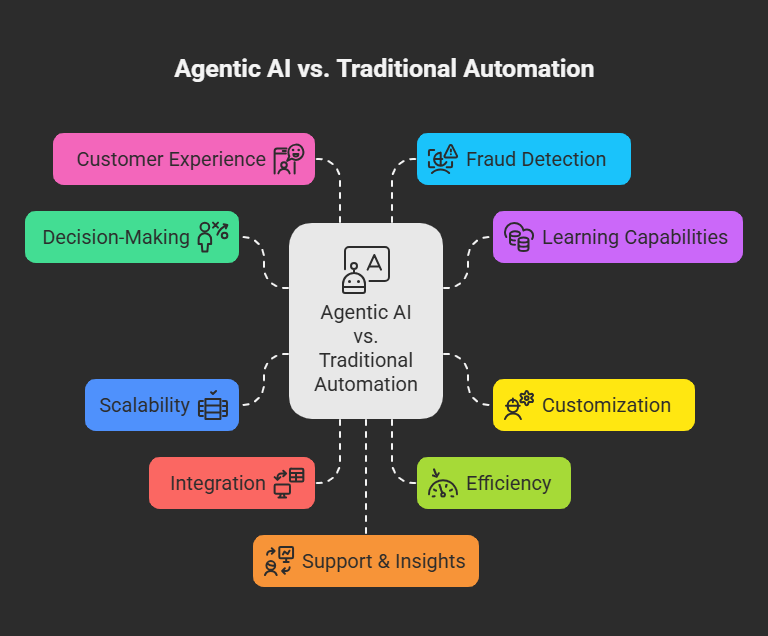
How Does Agentic AI Differ from Traditional Automation?
Estimated reading time: 12 minutes
Key Takeaways
-
- Agentic AI is an autonomous, adaptive decision-making system that goes beyond fixed task execution.
-
- Traditional automation relies on pre-programmed, rule-based workflows and requires human intervention for changes.
-
- Agentic AI brings continuous monitoring, self-correction, and learning capabilities to enterprise processes.
-
- The scalability and intelligence of agentic AI enable handling of complex, cross-system challenges effectively.
- Understanding these distinctions unveils the transformative potential agentic AI holds for the future of business.
Table of contents
In the rapidly evolving world of artificial intelligence, a transformative technology is rapidly capturing attention: agentic AI. As businesses race to optimize efficiency and innovation, many ask — how does agentic AI differ from traditional automation? This question is more than academic; understanding these differences unlocks the future of how organizations operate, compete, and innovate in an increasingly AI-driven landscape.
This blog post dives deep into this exciting frontier. We will unpack the core distinctions between agentic AI and traditional automation, explore their real-world applications, and reveal why agentic AI is poised to revolutionize not just automation but the entire AI ecosystem. Our coverage is rooted firmly in recent expert research and industry insights, with sources linked for further exploration. Prepare for a detailed and enlightening journey into the heart of modern AI!
Defining the Players: Traditional Automation vs. Agentic AI
Before comparing the two, let’s clarify what these terms mean.
Traditional automation refers to software systems designed to execute pre-programmed, repetitive tasks. These systems follow fixed sequences, like scripts or workflows, triggered by schedules or specific events. Examples include scheduled data extraction jobs (ETL pipelines), robotic process automation (RPA) bots for simple rule-based tasks, or scripts that handle system alerts. Traditional automation excels at speeding up routine operations but is limited by its rigidity and inability to adapt to change without human reprogramming.
In contrast, agentic AI represents an intelligent software agent capable of autonomous decision-making, learning, and goal-oriented behavior. Instead of blindly executing fixed instructions, agentic AI assesses situations, anticipates challenges, and actively determines the best ways to achieve high-level objectives. It incorporates advanced AI methods, such as large language models, reinforcement learning, and planning algorithms, enabling it to monitor environments, self-correct, and continually improve without human intervention.
To put it succinctly:
-
- Traditional automation is a tool that executes tasks.
- Agentic AI is a decision-making agent that achieves outcomes.
Core Differences Between Agentic AI and Traditional Automation
1. Autonomy and Initiative
One of the most profound differences lies in autonomy.
Traditional automation is fundamentally reactive and rigid. It follows fixed scripts and schedules (like cron jobs or ETL pipelines) and requires human intervention whenever unexpected situations arise or if the environmental conditions change. For example, if a data schema shifts or system inputs vary, traditional automation often fails to handle these disruptions and needs manual adjustments to resume correct operation (Matillion).
Agentic AI, however, is proactive and autonomous. It does not wait for instructions for every contingency; instead, it continuously monitors operations, detects anomalies or problems, and takes the necessary corrective actions independently. It sets goals, takes initiative, and navigates complex environments dynamically. This continuous initiative enables it to maintain workflow continuity without the constant need for human oversight (Matillion, AutomationEdge).
2. Adaptability
Traditional automation systems are notoriously brittle. If data formats change, new exceptions arise, or the process context shifts, these systems often break down. Recovery demands manual reprogramming or intervention, making scaling and maintenance costly and time-consuming (Matillion).
Agentic AI brings a remarkable shift: self-adaptation. It perceives and responds to “schema drift” — changes in data structure and anomalous patterns — without breaking or requiring human hand-holding. Through built-in feedback loops, agentic AI can refine its actions over time and self-heal broken workflows, ensuring seamless operations across changing and uncertain scenarios. This adaptive nature is critical for businesses that process high volumes of dynamic and heterogeneous data (Matillion, Agiliway).
3. Intelligence and Decision-Making
At the heart of agentic AI’s power is intelligence. Traditional automation behaves as a static system defined by preset rules. It cannot “think,” reason, or learn, and once deployed, it performs the same tasks repeatedly without improvement (AutomationEdge).
Agentic AI integrates cutting-edge AI components such as large language models (LLMs), reinforcement learning, and planning modules. This allows it to decompose high-level goals into actionable sub-tasks, reason across multiple interconnected systems, and learn from the results of its actions to optimize future performance. Over time, it becomes more efficient and effective — akin to a sophisticated problem solver or an expert collaborator within the enterprise system (Sprinklr, Agiliway).
4. Scalability
Scaling traditional automation is often cumbersome. Expanding coverage generally means increasing the number of engineers who must build and maintain brittle logic chains — complexities tend to grow linearly with scale, making sustainment harder (Matillion).
Agentic AI scales far more intelligently. Because it automates processes with adaptable and autonomous agents that adjust workflows on the fly, it can expand virtual workforce capacity exponentially without requiring direct human scaling of infrastructure or logic. This means organizations can handle more complex, diverse use cases and greater volumes efficiently (Matillion, AutomationEdge).
Practical Applications: A Side-by-Side Comparison
To better appreciate the real-world impact of these differences, consider how traditional automation and agentic AI behave when applied to specific operational challenges.
| Aspect | Traditional Automation | Agentic AI |
|---|---|---|
| Problem Detection | Breaks when unexpected conditions occur; errors are only found after manual review. | Continuously monitors systems, detects anomalies early, and self-corrects without human input. |
| Customer Service | Automatically routes tickets or suggests preset responses, but humans tackle complex multi-system issues. | Independently resolves complex cases by analyzing across multiple systems, determines root causes, takes corrective action, and performs follow-ups. |
| Data Integration | Schema changes force developers to manually adjust pipelines, causing downtimes. | Automatically detects schema drift and adapts pipelines to maintain uninterrupted operations. |
| Learning and Improvement | Performs the same tasks without change post-deployment; no learning capability. | Learns from outcomes, feedback, and new data, continuously improving efficiency and effectiveness over time. |
This transformative shift in operational capacity is what sets agentic AI apart as not just automation but an intelligent partner in enterprise digital transformation.
The Architectural Divide: How Agentic AI Works Differently
While both traditional automation and agentic AI involve algorithms and software programming, their underlying architecture differs substantially.
Traditional automation is architected around narrow, predetermined parameters and step-by-step instructions. It executes well-defined tasks but lacks context-awareness, memory of past states, or the ability to plan multiple steps ahead (Sprinklr).
Agentic AI, by comparison, sits atop a broader architecture composed of goal-setting mechanisms, memory modules, and reasoning engines. It interprets high-level objectives, recalls prior interactions and data contexts, reasons about complex scenarios across different enterprise systems, and orchestrates multi-step workflows autonomously (Sprinklr, Agiliway).
This architectural sophistication enables agentic AI to:
-
- Set and pursue dynamic goals,
-
- Learn from experience,
-
- Coordinate cross-functional digital processes,
-
- Adapt in real time to new or unforeseen information, and
- Scale up problem-solving capacity without direct human maintenance.
Why Does This Matter? The Business Value of Agentic AI
The distinction between traditional automation and agentic AI is not merely academic or theoretical. It represents a fundamental shift in how businesses will leverage AI to deliver value.
Traditional automation has long helped organizations reduce manual labor, avoid errors, and streamline routine processes. However, its limitations in flexibility and intelligence make it insufficient for handling the complexity and dynamism of modern business environments.
Agentic AI, by contrast, unlocks unprecedented opportunities:
-
- Reduced operational risk due to its continuous monitoring and self-healing capabilities,
-
- Increased efficiency through autonomous decision-making and adaptive workflows,
-
- Enhanced customer experience via intelligent issue resolution without waiting for human intervention,
-
- Greater innovation by handling complex, cross-system problems that were previously impossible to automate,
- Cost savings by minimizing manual involvement and maintenance overhead in complex automation pipelines.
No wonder the technology world is buzzing about agentic AI as a cornerstone of next-generation AI solutions.
Looking Ahead: The Future Evolution of Intelligent Automation
As agentic AI technologies mature, their integration into enterprise operations will become more pervasive. Future agentic systems will likely incorporate even more sophisticated cognitive abilities such as emotional recognition, advanced natural language interaction, and real-time learning from human collaborators.
The boundary between automation and autonomous intelligence will continue to blur, ushering in an era where AI agents are not just tools but true collaborators that understand, anticipate, and co-create with humans.
For organizations, embracing agentic AI now means positioning themselves at the vanguard of this transformation — reaping the benefits of agility, scalability, and intelligent decision-making that will define successful enterprises in the AI era.
In Conclusion
How does agentic AI differ from traditional automation? The answer lies in autonomy, adaptability, intelligence, scalability, and architectural design. While traditional automation executes fixed, rule-based tasks, agentic AI proactively initiates actions, adapts to changing environments, reasons to solve complex problems, learns from its experiences, and scales intelligently.
Grounded in robust research (Matillion, AutomationEdge, Sprinklr, Agiliway, Databricks Community), this new paradigm promises to revolutionize how enterprises operate — making agentic AI a thrilling frontier in artificial intelligence.
Ready to explore how agentic AI can transform your business processes? Keep following our blog for the latest updates and insights in AI innovation!
Frequently Asked Questions
What is agentic AI?
- Agentic AI is an autonomous AI system capable of decision-making, learning, and goal-directed behavior, going beyond traditional automation's fixed task execution.
- How does agentic AI handle unexpected situations differently from traditional automation?
- Unlike traditional automation which fails or requires reprogramming, agentic AI proactively detects anomalies and self-corrects without human intervention, ensuring continuous operation.
- Can agentic AI learn and improve over time?
- Yes, agentic AI integrates learning mechanisms such as reinforcement learning enabling it to refine strategies and improve its effectiveness from experience.
- Is agentic AI scalable for complex enterprise needs?
- Agentic AI scales intelligently by adapting workflows dynamically, unlike traditional automation which often requires linear increases in human maintenance.
- Where can I learn more about the differences between agentic AI and traditional automation?
- For detailed insights, you can explore resources such as Matillion, AutomationEdge, and Sprinklr.