

Unlocking Enterprise Productivity: A Comprehensive Guide to the Google AI Agent Handbook and Its 10 Practical Use Cases
Unlocking the Future of Work with the Google AI Agent Handbook
Estimated reading time: 12 minutes
Key Takeaways
-
- The Google AI Agent Handbook empowers enterprises to harness “agentic AI” for complex workflows and productivity gains.
-
- AI agents act autonomously and specialize in roles, augmenting human work with multi-step reasoning and secure, unified data access.
-
- The handbook presents 10 practical hacks showcasing AI agent applications across various business functions like research, support, marketing, coding, and operations.
-
- Google Cloud provides a robust technical stack including Gemini Enterprise, Agent Development Kit, and RAG to build reliable, scalable agents.
- Practical advice highlights starting narrow, leveraging prebuilt agents, iterating with users, and enforcing security for successful AI agent adoption.
Table of contents
What Exactly is the Google AI Agent Handbook?
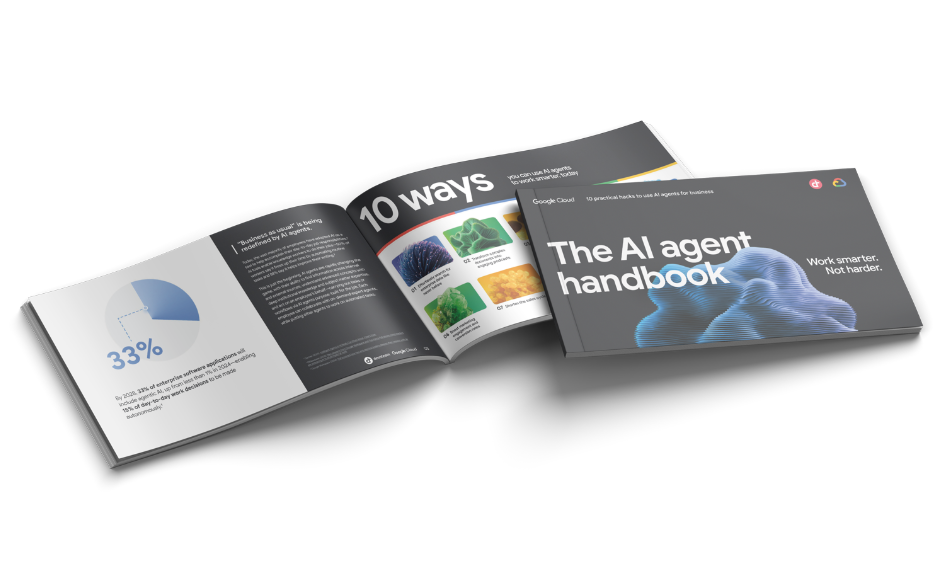
At its core, the Google AI Agent Handbook is a detailed guide provided by Google Cloud, designed with a business-first lens. It focuses on enterprise AI agents—software entities powered by advanced machine learning models like Google’s Gemini—that do far more than answer simple queries.
Rather than being simple assistants, these agents act autonomously to run complex, multi-step workflows, uniting disparate data sources and tools to complete tasks usually requiring expert human judgment.
The handbook’s mission is clear and ambitious: to demonstrate how AI agents can become the new cornerstone of enterprise productivity. It does so by outlining 10 practical “hacks”—or use cases—showing enterprises how to deploy AI agents effectively across marketing, coding, customer service, research, and operations.
It also highlights Google Cloud’s AI offering such as Gemini Enterprise and Agent Space, showcasing how these technologies enable agent-driven workflows. Explore the resource on the Google Cloud AI Agent Handbook page.
Demystifying AI Agents: What the Handbook Means by “Agentic AI”
To appreciate why the Google AI Agent Handbook is revolutionary, we must understand what it means by AI agents. These agents redefine software capabilities beyond traditional automation:
-
- More than Chatbots: AI agents built on large models like Gemini do not simply respond to questions; they take actions, call APIs, and execute multi-step workflows—acting like digital coworkers who perform tasks, not just conversations.
-
- Specialized for Roles: Tailored around job functions, such as a research agent condensing information into reports, a support agent handling tickets autonomously, or a coding agent generating code. These agents collaborate with employees, amplifying human expertise.
-
- Unified, Secure Data Access: A centralized, secure data foundation aggregates all enterprise knowledge—emails, CRM, chat logs, support tickets, policies—giving agents the context needed to complete workflows seamlessly.
- Reasoning and Planning: These agents break down complex goals into manageable steps, synthesize internal and external information, and strategically plan workflows to deliver actionable outcomes.
This heralds the dawn of an “era of enterprise AI agents”, where AI moves from tool to teammate, revolutionizing work itself. For more insight, see this detailed walkthrough on YouTube.
The 10 Practical Hacks: How AI Agents Supercharge Enterprise Workflows
The Google AI Agent Handbook excites by focusing on real-world applications. It outlines 10 key hacks, or use-case patterns, illustrating how AI agents enhance business functions:
1. Unified Enterprise Search and Workspace Assistance
Employees face scattered information silos—CRM, emails, support tickets, sales documents—across many systems. The handbook introduces an Agent Space, a single hub where natural language requests aggregate data from all sources.
Example request:
“Show me the recent interaction history for customer jane.doe@example.com from CRM, email, support tickets, all at once.”
This streamlines workflows, cutting search time and errors (source).
2. Deep Research and Strategic Analysis
AI agents automate complex research by:
- Crafting custom research plans.
- Running intricate queries across internal and web databases.
- Filtering, consolidating, synthesizing vast data.
- Producing structured, actionable reports.
Ideal for market intelligence and strategic planning (source).
3. Content Creation and Idea Generation at Scale
Marketing teams upload briefs into a notebook-style environment and ask agents for multiple campaign ideas. The agent returns concepts with pros and cons, speeding ideation and decision-making (source).
4. Customer Support & High-Volume Interaction Handling
Agents analyze tickets, CRM data, and knowledge bases to:
- Draft response suggestions and recommend next actions.
- Escalate complex cases with context to humans.
- Reduce resolution time, enhance satisfaction.
This automation scales support while preserving quality (source).
5. Code and Automation Agents
Developers deploy AI agents to generate boilerplate code, tests, and automation scripts. These agents also integrate with CI/CD and logging tools, enabling even non-technical staff to build workflows quickly (source, source).
6. Document Understanding and Policy or Compliance Assistance
Agents read and interpret contracts, policies, and regulations, answer compliance queries, highlight legal risks, and assist employees in following rules without manual document searching (source, source).
7. Sales and Account Intelligence
Sales AI agents gather detailed customer data from CRM, emails, and business signals to prep reps with actionable insights that empower deal closures (source).
8. HR, Onboarding, and Internal Enablement
HR agents answer benefits and policy questions, guide onboarding, and streamline internal processes, enabling 24/7 employee support and freeing staff for strategic work (source, source).
9. Operations, Ticket Triage, and Routing
Operations teams rely on AI agents to classify, route, and resolve routine IT tickets automatically, routing complex issues with context to humans—boosting workflow efficiency and customer satisfaction (source, source).
10. Cross-functional “Copilot” Experiences
These multi-tool agents combine previous capabilities, for example:
- Summarizing team updates.
- Flagging project risks.
- Drafting communications and action plans.
Transforming team coordination and delivery with comprehensive AI assistance (source, source).
The Technology Behind the Magic: Google Cloud’s AI Agent Stack
Underpinning this business innovation is a sophisticated technical stack outlined in the developer guide “Startup technical guide: AI agents”. Highlights include:
Google Cloud Platform Components
-
- Vertex AI Platform: Model hosting, orchestration, training, inference, and monitoring at scale.
-
- Vertex AI Model Garden: Catalog of powerful models like Gemini for diverse workloads.
-
- Agent Development Kit (ADK): Tools enabling developers to build agents able to reason, use APIs, and manage workflows.
- Gemini Enterprise / Gemini Advanced: Advanced, production-grade multimodal models for complex text and image understanding.
Retrieval-Augmented Generation (RAG)
To mitigate AI hallucinations, agents incorporate RAG: indexing enterprise data and dynamically retrieving relevant documents, grounding outputs on real data rather than guesses.
Multimodal Capabilities
Gemini processes diverse inputs—screenshots, text, images—empowering agents in marketing and product workflows involving varied media.
AgentOps and Productionization
The Agent Starter Pack enables safe, scalable deployment with:
- Observability and action tracing.
- Continuous quality evaluation and improvement.
- Integrated safety policies and responsible AI governance.
This ensures reliability and compliance in enterprise settings (source).
Getting Started with AI Agents: Practical Steps from the Handbook
The handbook includes actionable advice for integrating AI agents:
1. Establish a Unified Data Foundation
Connect critical systems—email, CRM, chat, HR, ticketing—into a secure data layer, providing agents full context for automation (source).
2. Start Narrow with High-Impact Use Cases
Focus on one or two workflows with clear impact, such as support deflection or sales briefing generation, to gain quick wins and foster adoption (source, source).
3. Leverage Prebuilt Agents
Use Google’s ready-made agents like Agent Space and the deep research agent to accelerate time to value (source).
4. Iterate with Users in the Loop
Deploy agents as assistants initially, monitor usage, gather feedback, and progressively expand automation to ensure quality and buy-in (source, source).
5. Prioritize Security and Responsible AI
Implement role-based access and data governance, and use Google Cloud’s responsible AI tools to enforce safety and monitor compliance (source, source).
Complementary Google Cloud Resources for AI Agents
Google Cloud offers a suite of complementary resources alongside the AI Agent Handbook:
-
- The business-focused AI Agent Handbook emphasizes use cases and productivity impacts tied to Gemini Enterprise and Google Cloud tools.
-
- The startup technical guide provides architectural patterns and production best practices for developers.
- Extensive video walkthroughs and expert talks supplement the materials, deepening understanding and showcasing demos (source).
Final Thoughts: Why the Google AI Agent Handbook is a Game-Changer
The Google AI Agent Handbook marks a crucial evolution in enterprise AI. It transcends hype and chatbots to reveal versatile AI agents capable of overhauling vital business workflows. Through practical hacks, technical guidance, and a forward-looking vision, it equips organizations to revolutionize how work happens—faster, smarter, and at scale.
Organizations that embrace these new AI teammates stand to unlock major productivity, reduce friction, and innovate customer and employee experiences. As this “team member AI” era unfolds, the handbook serves as an essential guide for confidently stepping into the future of work.
For full details, explore the Google AI Agent Handbook and the companion technical guide at https://cloud.google.com/resources/content/building-ai-agents.
Stay curious, stay ahead, and watch as your new AI teammates transform your business workflows!
Frequently Asked Questions
What is agentic AI?
Agentic AI describes software agents that not only respond to queries but autonomously take actions, execute workflows, and collaborate with human workers. They are designed to solve complex, multi-step tasks across enterprise functions.
How do AI agents differ from chatbots?
Unlike chatbots that answer questions, AI agents invoke APIs, integrate multiple systems, and perform multi-step reasoning to complete workflows, acting more like expert teammates than conversational assistants.
What are some practical use cases for AI agents?
Use cases include unified enterprise search, deep research, content ideation, customer support automation, code generation, compliance assistance, sales intelligence, HR enablement, IT ticket triage, and cross-functional copilot roles.
How does Google Cloud support AI agent development?
Google Cloud provides Vertex AI Platform and Model Garden, Agent Development Kit, Gemini models, and comprehensive tools for observability, governance, and production-grade deployment.
How can enterprises get started with AI agents?
Start by building a unified data foundation, select high-impact workflows, use prebuilt agents, iterate with users, and enforce responsible AI and security policies per the handbook’s guidance.